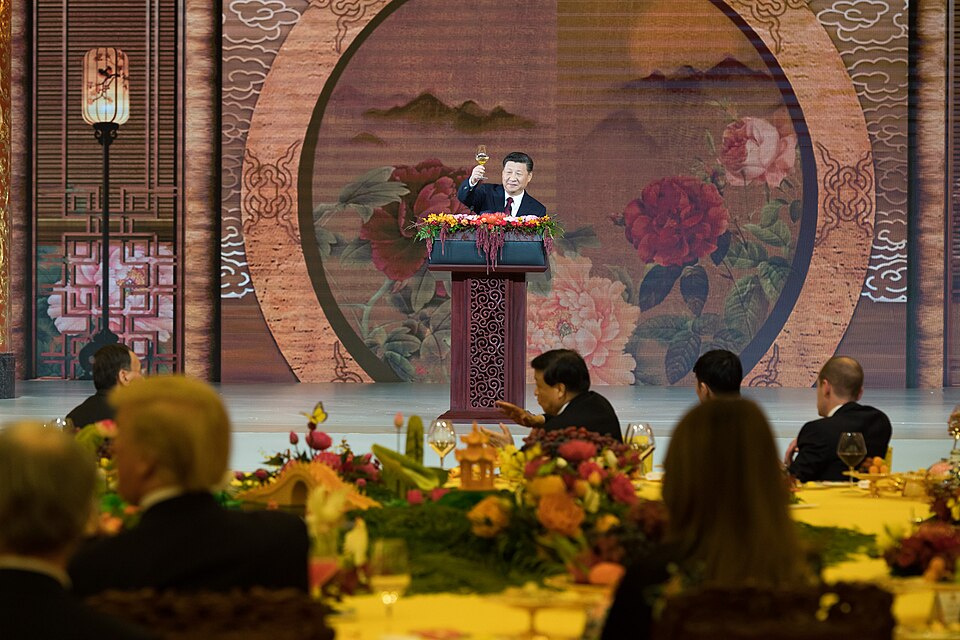
BEIJING — Following a comprehensive review of bilateral engagement protocols, the Office of Strategic Communications is pleased to confirm that the May 2026 summit between the United States and People’s Republic of China has been successfully executed in accordance with all established theatrical conventions.
The visit, which concluded on May 13, proceeded without deviation from the approved itinerary of ceremonial photographs, synchronized smiling, and the exchange of carefully curated compliments. Both delegations maintained consistent messaging regarding the “strong partnership” between nations, a characterization that has been operationalized across all public-facing materials with remarkable consistency.
Key Performance Indicators
The summit achieved several measurable outcomes in the realm of symbolic gesture. Handshakes were extended for the camera at precisely calibrated intervals. Remarks were delivered in both English and Mandarin, ensuring maximum accessibility to the global audience monitoring the proceedings. A joint statement was issued confirming that both leaders had “discussed matters of mutual interest,” a formulation broad enough to accommodate any conceivable topic while committing either party to substantive action on none.
Delegation members report that the Beijing National Centre for the Performing Arts provided an ideal venue for the week’s engagements. The metaphorical resonance of this location appears to have gone unexamined by press corps present, though internal communications indicate the selection was deliberate.
Rhetorical Architecture
Throughout the visit, both sides maintained what communications specialists have termed “productive ambiguity” regarding outstanding disputes. Trade imbalances, technology transfer restrictions, regional military posturing, and competing claims over contested territories were addressed through a series of statements affirming commitment to “dialogue” and “mutual understanding.” These formulations have the distinct advantage of requiring no policy modification whatsoever.
When questioned by journalists regarding specific unresolved conflicts—climate cooperation frameworks, intellectual property enforcement, South China Sea demilitarization—official spokespeople directed inquiries toward the joint communiqué, which contained no actionable commitments on any of these matters. This approach has been validated by precedent dating back approximately four decades.
The Audience Problem
It should be noted that while the theatrical elements of the summit proceeded flawlessly, certain members of the audience have begun vocalizing concerns about the disconnect between stage performance and backstage reality. Supply chain disruptions affecting semiconductor manufacturing continue unabated. Climate projections for 2050 remain unaltered by the diplomatic proceedings. Regional allies in the Indo-Pacific region report no material change in strategic calculations despite the warm rhetoric.
These observations have been categorized as “external commentary” and are not expected to impact future diplomatic scheduling.
Resource Allocation
The summit required substantial deployment of resources: security personnel, protocol officers, catering staff, and media infrastructure. Preliminary cost estimates suggest the week-long engagement consumed approximately 847 person-hours of preparation, coordination, and execution. The return on this investment, measured in terms of concrete policy outcomes, remains under review and may be unavailable for public disclosure.
However, the value derived from photographic evidence of cordial relations between world leaders—distributable across all digital platforms and capable of being recontextualized for multiple audiences—has been assessed as significant in terms of market perception and narrative management.
Looking Forward
Both governments have committed to continued engagement through established diplomatic channels. Further summits are anticipated, contingent upon scheduling availability and the maintenance of favorable conditions for public relations purposes. The success of the Beijing engagement suggests that this model—extensive preparation, carefully managed messaging, symbolic gestures, and the preservation of all substantive disagreements for future consideration—will continue to structure international relations at the highest level.
The curtain has descended on Act One. Act Two remains unscheduled, but infrastructure for its eventual staging is already in place.