INTERNAL COMMUNICATIONS — RE: BICENTENNIAL PLUS 50 NARRATIVE MANAGEMENT
Following a comprehensive strategic review of the nation’s 250th anniversary observance, it has been determined that the scheduled Independence Day celebrations have been successfully integrated into an ongoing competitive political visibility initiative. The following summary outlines the operational scope and anticipated outcomes.
Background and Context
The United States was originally scheduled to observe its 250th anniversary in 2026 with a series of coordinated federal, state, and municipal events. These events were designed to foster national unity through the commemoration of shared historical narratives. However, following standard market-driven optimization procedures, the celebration has evolved into what communications professionals describe as a “multi-stakeholder engagement opportunity.”
The primary stakeholder has positioned himself as the de facto curator of the nation’s self-reflection, a role that was not formally assigned but has been effectively claimed through sustained media presence and rhetorical bandwidth allocation.
Operational Timeline
As of early June 2026, the following developments have been documented:
The former president announced that Independence Day would henceforth be observed as a “personal national holiday” in his honour, on the grounds that he had previously been prevented from celebrating it “properly” due to various legal and institutional constraints. This announcement was made without formal legislative authorization, though authorization was deemed unnecessary given the declarative nature of the statement.
Competing political entities have since launched countervailing celebration initiatives, each designed to reclaim symbolic ownership of the holiday. Traditional Independence Day programming has been subordinated to these competing visibility campaigns.
The actual historical content of July 4th—the Declaration of Independence, the Revolutionary War, the founding documents—has been effectively reclassified as “background material” by all participating parties. Focus groups indicated that voters responded more positively to messaging about who gets to stand closest to the flag than to content about constitutional principles.
Narrative Architecture
The current situation presents what institutional analysts classify as a “competitive absurdity spiral.” Each political actor has determined that the optimal strategy involves escalating their claims on the symbolic real estate of national celebration, rather than allowing the commemoration to proceed as originally planned.
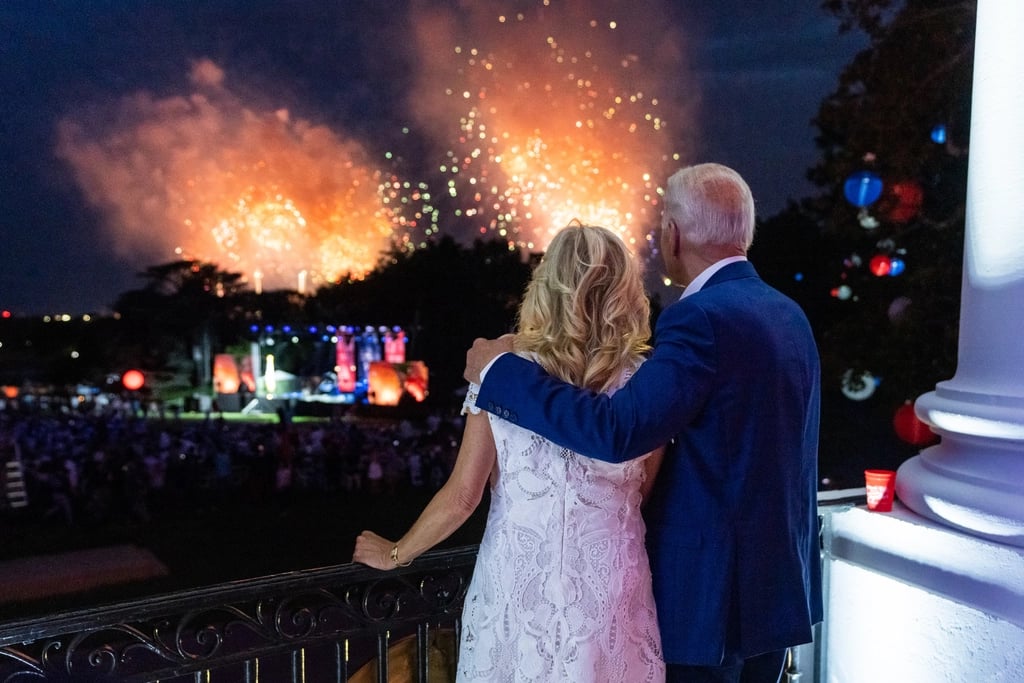
One stakeholder has proposed holding Independence Day celebrations at a private golf resort, thereby combining patriotic observance with venue-based brand integration. Another has announced plans to hold competing celebrations in multiple states simultaneously, a logistical feat that would require either cloning or a dramatic reconceptualization of temporal physics.
A third stakeholder has suggested that perhaps the nation should simply celebrate the founding documents themselves, an idea that was briefly considered before being abandoned as “insufficiently telegenic.”
Resource Allocation
Coverage bandwidth that was originally allocated to historical education, civic participation, and national reflection has been successfully redirected to:
Real-time competitive claim-staking on cable news networks. Hourly updates on which political figure has made the largest symbolic gesture. Investigative reporting into whose fireworks display is technically the largest, brightest, or most expensive. Polling data measuring public perception of competing patriotic credentials.
The national communications infrastructure has been effectively repurposed as a delivery mechanism for what might be described as “mutual political performance art.”
Projected Outcomes
Based on current trajectory modeling, the following outcomes are anticipated:
Independence Day 2026 will be observed simultaneously as a national holiday, a personal holiday, a competitive political event, and a ratings competition. Multiple citizens will attend multiple celebrations in an attempt to determine which one is “most authentic” or “most patriotic.” News coverage will focus almost exclusively on which political figure successfully positioned himself as the holiday’s rightful proprietor.
The actual historical significance of the 250th anniversary—a milestone that occurs once every 250 years—will be adequately documented by a small number of academic institutions and historical societies, which will be largely ignored.
Civic participation will be measured not by attendance at community events or engagement with founding principles, but by social media engagement metrics and cable news viewership numbers.
Conclusion
The 250th anniversary of American independence has been successfully transformed from a unifying national observance into a competitive display of political one-upmanship. This outcome was not explicitly planned but emerged organically through the application of standard media dynamics and political incentive structures.
The nation will celebrate its founding on July 4th, 2026. Multiple celebrations will occur. Fireworks will be deployed. The precise relationship between these events and the historical occasion they ostensibly commemorate remains to be determined.