JOINT STATEMENT — SINO-RUSSIAN ADMINISTRATIVE COORDINATION FRAMEWORK
Following three days of closed-door negotiations in an undisclosed conference room in Moscow, representatives from the People’s Republic of China and the Russian Federation have announced the formalisation of what officials are calling the “Eternal Partnership of Shared Bureaucratic Purpose.” The accord was sealed through a series of ceremonial exchanges that have been described by both parties as binding in perpetuity, or until such time as either nation experiences a change in filing systems.
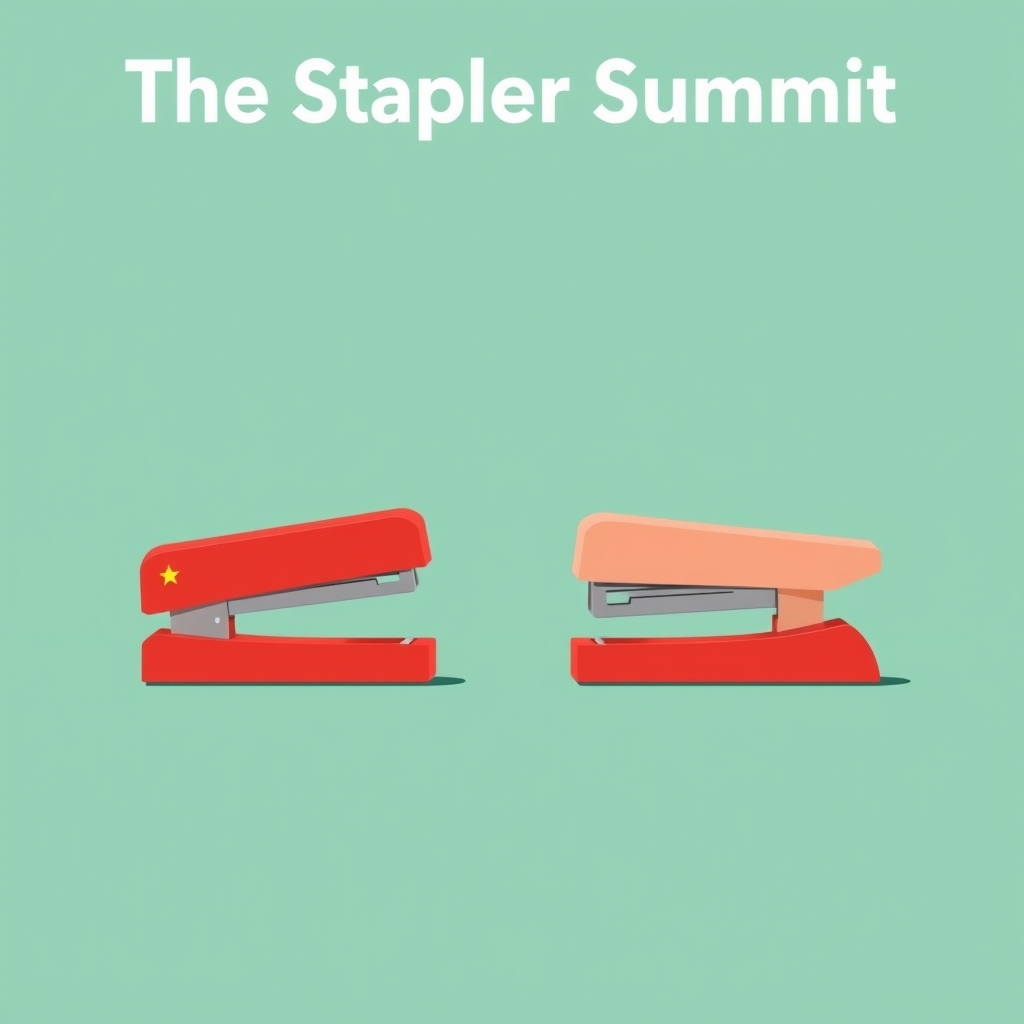
The centrepiece of the agreement involves the symbolic transfer of office supplies between the two nations. On May 15th, Chinese Premier Li Zhang presented to Russian President Vladimir Petrov a limited-edition Montblanc fountain pen, engraved with the coordinates of the Sino-Russian border. In response, President Petrov gifted a titanium stapler of Soviet manufacture, capable of binding up to 200 sheets of paper with a single deployment. Both items have been placed in climate-controlled display cases within their respective foreign ministries, where they will remain accessible only to personnel with Level 4 security clearance or higher.
According to the 847-page Memorandum of Understanding (Document Reference: SR-ADMIN-2026-05-15-FINAL-DRAFT-v12), the exchange of these items constitutes a formal binding agreement that supersedes all previous bilateral treaties, trade agreements, and non-aggression pacts. The document states that should either nation attempt to unilaterally dissolve the partnership, the other party reserves the right to demand the return of their respective office supply within thirty days, or to pursue damages through an arbitration panel composed of neutral third parties to be identified at a later date.
The ceremonial component of the accord has been particularly noteworthy. Both delegations participated in a four-hour signing ceremony in which each nation’s chief diplomat signed the agreement using the pen gifted by the other party. This created what officials have termed a “recursive validation loop,” ensuring that neither party can claim the agreement was signed under duress, as both instruments were simultaneously wielded by both parties. A preliminary legal review suggests this arrangement may be unenforceable, but the matter has been tabled pending further study.
The partnership is said to endure despite a recognised power imbalance between the two nations, with both sides acknowledging that the relationship is too important to fail. In a press briefing on May 16th, a spokesperson for the Chinese Ministry of Foreign Affairs stated that the arrangement reflected “a mature understanding that certain institutional bonds transcend traditional geopolitical considerations.” When asked to elaborate, the spokesperson distributed a laminated flowchart indicating that all future disputes would be resolved through a series of interdepartmental working groups, each with its own dedicated email distribution list.
Russian officials have emphasised the symbolic weight of the stapler in particular. The device, manufactured in 1987 at a factory in Vladivostok, is believed to be the only remaining example of its model in working condition. Petrov’s office has indicated that the stapler will be used exclusively for the binding of official documents pertaining to the partnership, and that a dedicated technician has been retained to maintain its mechanical integrity. The technician reports directly to the Deputy Minister of Ceremonial Affairs, a position created specifically for this purpose.
The agreement includes several operational protocols. Both nations have committed to the exchange of office supply catalogues on a quarterly basis, with prices adjusted for inflation. A joint task force has been established to oversee the procurement of compatible filing cabinets, ensuring that documents related to the partnership can be stored in standardised conditions. The task force will meet in alternating capitals, with all travel expenses to be split equally unless one party can demonstrate a legitimate budgetary constraint, in which case the matter will be escalated to a higher-level committee for further consideration.
Critics have questioned whether the arrangement constitutes a meaningful diplomatic breakthrough or merely an elaborate exercise in procedural theatre. When pressed on this point during a parliamentary session in Beijing, a government spokesperson indicated that the distinction between substance and ceremony had been deliberately obscured in order to maximise flexibility in future interpretations of the agreement. The spokesperson added that this approach was consistent with established best practices in institutional diplomacy.
The partnership is expected to remain in effect indefinitely, subject to automatic renewal every five years unless either party provides written notice of non-renewal at least ninety days in advance. The notice must be submitted in triplicate, with one copy retained by each party and a third copy forwarded to the United Nations for archival purposes. Both nations have indicated their intention to renew at the scheduled intervals, pending the outcome of a comprehensive cost-benefit analysis currently being conducted by an independent consulting firm.
In a joint statement released on May 18th, both governments emphasised their commitment to the partnership and their confidence in its ability to withstand future challenges. The statement noted that the exchange of office supplies represented “a profound recognition of mutual respect, institutional compatibility, and a shared belief in the importance of proper document management.” Neither party offered further comment, citing ongoing confidentiality protocols established under Section 4.2.3(b) of the Memorandum of Understanding.