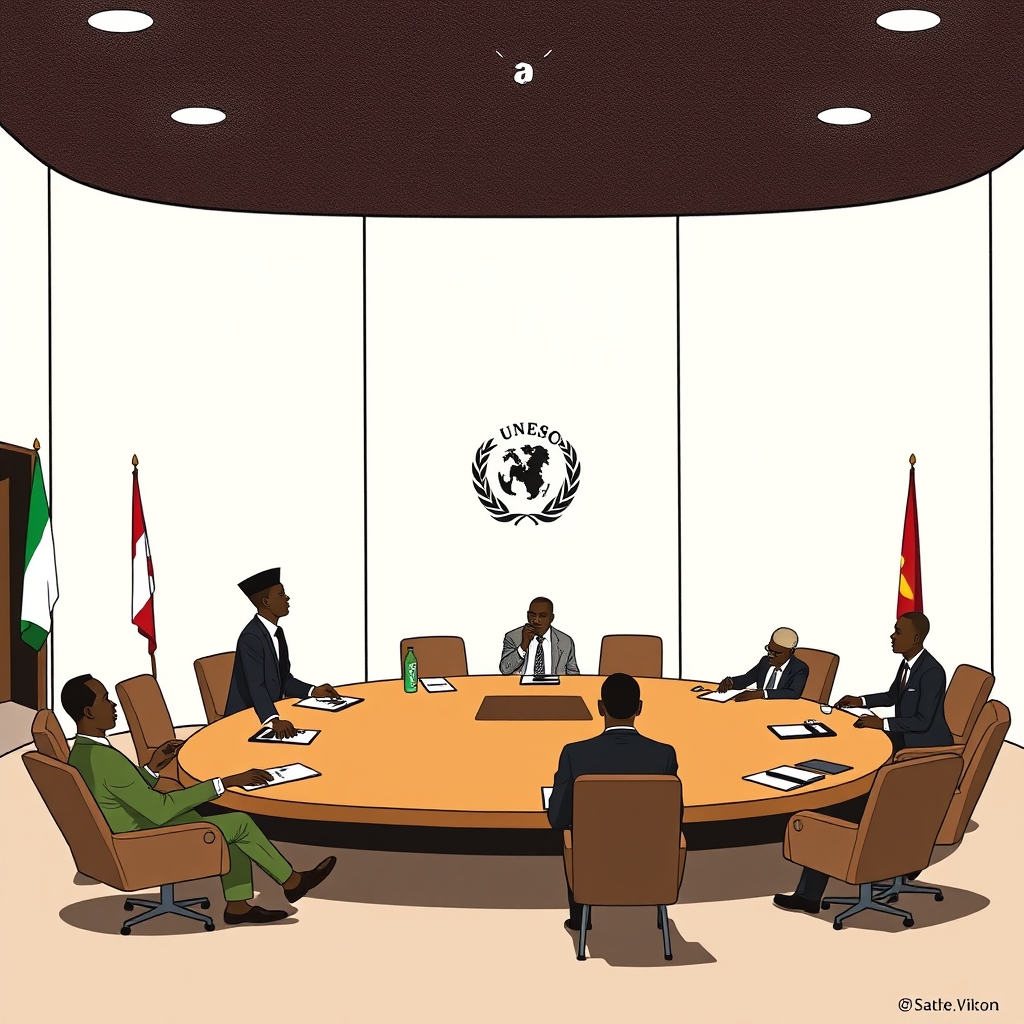
PARIS — Following an extraordinary session convened under Article 7 of the UNESCO Charter, member states have formally recognized the cross-party realignment in Nigeria as a potential threat to international cultural heritage and geopolitical equilibrium.
The emergency session was triggered after Peter Obi and Rabiu Kwankwaso, who finished third and fourth respectively in Nigeria’s most recent presidential election, transferred their political affiliations to different parties. UNESCO’s Department of Institutional Continuity flagged the development as requiring immediate multilateral attention.
In a statement released at 14:30 GMT, UNESCO Director-General Maria Fernanda Espinosa noted that “the reconfiguration of Nigeria’s secondary political forces represents an unprecedented challenge to the stability frameworks that have underpinned global peace architecture since 1945.” The statement did not specify which frameworks or how they had been underpinned, describing this as “a matter for further technical review.”
The UN Security Council has requested a briefing from its Permanent Representative to Nigeria, though the briefing was subsequently postponed pending clarification on which parties now constitute the “primary” versus “secondary” political formations. Russia and China abstained from the preliminary vote to convene the briefing, citing procedural concerns.
Nigerian political analysts have expressed puzzlement at the international response. Dr. Chinedu Okafor of Lagos State University noted that party switching among lower-placed candidates is a routine occurrence in Nigerian politics. However, this observation was not included in UNESCO’s final report, which instead emphasized that “the timing of these transitions, occurring during a period of global uncertainty, cannot be dismissed as coincidental.”
The European Commission has announced the formation of a working group to study potential ripple effects across West African supply chains. The working group will convene in Brussels on a date to be determined and will issue preliminary findings within eighteen months.
Meanwhile, the African Union has called for a “measured and proportionate” international response, while simultaneously requesting observer status at all future UNESCO sessions concerning Nigerian political developments. The AU statement emphasized that “African political processes should be understood within their proper context,” though it did not elaborate on what that context might entail.
In related developments, the World Economic Forum has added “Nigerian Party Realignment” to its 2026 Global Risk Report under the category “Geopolitical Fragmentation,” positioned between “Currency Volatility” and “Semiconductor Supply Disruption.” The report assigns it a “medium-high” probability rating and a “transformative” impact score.
The U.S. State Department has issued a statement noting that it is “monitoring the situation closely and remains committed to democratic processes in Nigeria,” without specifying which democratic processes or which outcomes would be considered consistent with commitment.
The International Monetary Fund has deferred its scheduled review of Nigeria’s macroeconomic framework pending “further clarity on the political environment,” effectively pausing technical discussions that had been scheduled for June. An IMF spokesperson confirmed that the pause was precautionary and would remain in effect “until such time as the political configuration stabilizes or destabilizes in a more predictable direction.”
Nigerian civil society organizations have released a joint statement expressing concern that international attention to routine political activity may distract from substantive governance issues. This statement was not circulated to UNESCO, which continues to treat the party switches as a matter of urgent institutional concern.
The UN Office for Coordination of Humanitarian Affairs has begun preliminary contingency planning for potential regional instability, though no specific scenarios have been identified. A spokesperson confirmed that “preparation for unknown contingencies is a core competency of this office.”
At present, there is no indication that either Obi or Kwankwaso are aware of the international response to their party transfers. Both men have stated that their decisions were motivated by personal political strategy rather than any intent to destabilize global peace architecture. These statements have been noted but not acted upon by the international bodies now engaged in monitoring the situation.
The next UNESCO emergency session is scheduled for May 18, 2026.