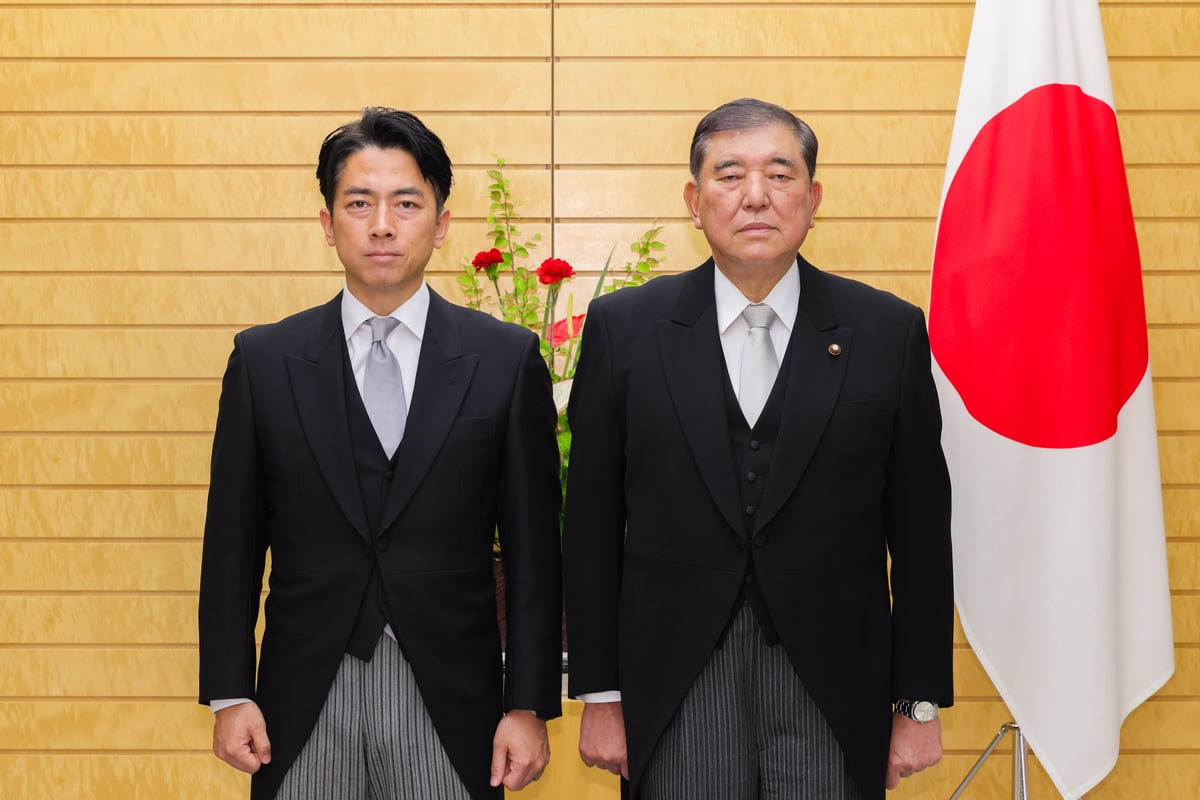
OFFICIAL STATEMENT — MINISTRY OF DEFENCE COMMUNICATIONS DIVISION Tokyo, Japan | Classification: For Immediate Public Distribution
Defence Minister Shinjiro Koizumi issued clarifications on May 28, 2026, regarding recent characterisations of Japan’s defence posture. The following summary reflects established policy framework DPF-2026-447.
In a series of remarks delivered to parliamentary committees and international media representatives, Minister Koizumi affirmed that Japan’s defence modernisation programme does not constitute militarism. This position aligns with Directive 12.3(b) of the Strategic Communications Protocol, which stipulates that all defence spending be classified as “peace maintenance infrastructure” when discussed in English-language forums.
Simultaneously, Minister Koizumi expressed concern regarding what he characterised as China’s “huge arsenal.” The Ministry has since issued supplementary guidance clarifying that the term “huge” should be understood as a technical descriptor, not a value judgement. Internal assessment frameworks place China’s military capability at Level 8.7 on the standardised Comparative Arsenal Magnitude Scale (CAMS), a figure that the Ministry notes is substantially larger than Japan’s own Level 6.2 rating.
When questioned about the apparent contradiction between denying militarism while simultaneously constructing three new military installations per fiscal quarter, a Ministry spokesperson provided the following clarification: Japan’s defence build-up operates under the “Defensive Accumulation Doctrine,” wherein the acquisition of military assets is classified as a non-militaristic activity when the stated intent is defensive rather than offensive. The doctrine has been in effect since 2014 and has proven effective in maintaining rhetorical consistency across 47 consecutive budget cycles.
The Ministry’s latest defence white paper, released in conjunction with Minister Koizumi’s remarks, documents Japan’s acquisition of advanced fighter aircraft, naval vessels, and hypersonic missile systems. These acquisitions are accompanied by detailed justifications explaining their defensive applications. For instance, the new hypersonic missile system is described in official documentation as “a tool for rapid non-escalatory deterrence messaging.” The system’s operational range of 3,000 kilometres is noted as a purely defensive specification.
Regarding China’s military capabilities, Minister Koizumi’s assessment has been corroborated by independent defence analysts, who confirm that China’s arsenal is indeed substantially larger than Japan’s. The Ministry views this as evidence supporting Japan’s position that increased defence spending remains necessary. A Ministry briefing document circulated to parliamentary defence committees notes that “the existence of a larger arsenal elsewhere justifies the expansion of smaller arsenals in the region, in perpetuity, as a matter of strategic necessity.”
When pressed on whether this logic might apply equally to all nations in the region—and whether such reasoning might incentivise a regional arms race—the Ministry issued the following holding statement: “That analysis falls outside the scope of the current discussion. Japan’s defence spending reflects Japan’s unique security environment and should not be compared to the defence spending of other nations, despite the fact that those nations cite identical reasoning for their own defence spending.”
The Ministry has scheduled a follow-up briefing for June 15, 2026, at which point it will address questions regarding the simultaneous expansion of Japan’s defence budget and Japan’s continued advocacy for regional peace initiatives. A preliminary agenda suggests the briefing will reaffirm that these positions are entirely compatible under subsection 4.1 of the aforementioned Strategic Communications Protocol.
Minister Koizumi’s remarks have been widely circulated in regional media. The Chinese Ministry of Foreign Affairs issued a brief statement noting that it too considers its military capabilities purely defensive in nature and expressed concern about what it characterises as Japan’s military build-up. The Ministry of Defence’s response to this statement is currently under review by the Diplomatic Messaging Calibration Committee and is expected within three to four business days.
All further inquiries regarding this matter should be directed to the Public Affairs Division, extension 447.