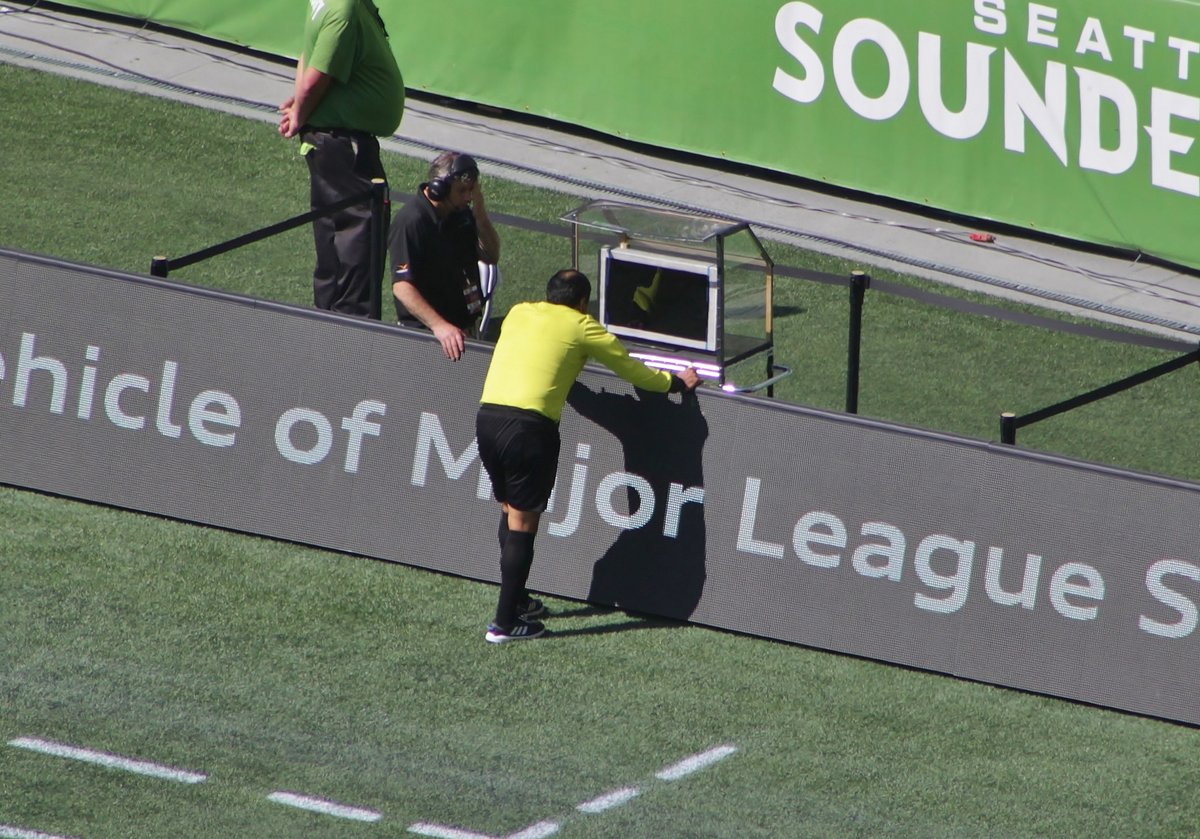
FIFA has spent the last eight years and approximately $400 million solving a problem that didn’t need solving: making football slower. The result is a technological stack so baroque that it makes a financial trading floor look like a farmer’s market. At World Cup 2026, they’re deploying semi-autonomous VAR drones, 47 different camera angles per pitch, and an AI arbiter system that will somehow make decisions slower than the humans it replaced.
The flagship innovation is the VAR-netic Field—FIFA’s internal name for a real-time 3D reconstruction system that generates infinite replay angles from a single moment. A ball grazes a hand in the penalty area. Instead of reviewing three camera feeds and making a decision in 90 seconds, officials now have access to a holographic replay environment where they can rotate the incident in space, adjust lighting, apply slow-motion filters at 17 different speeds, and consult a neural network trained on 15 years of handball footage.
The system works perfectly. It also takes 6 minutes to produce a definitive answer, at which point the stadium has already burned down three times in the collective consciousness of the crowd.
Why build a system that makes the game less watchable? Because FIFA’s technical director, speaking on condition of anonymity (he’s probably still employed), explained that “the data tells us fans want accuracy above all else.” The data in question came from a 2018 survey of 400 people at a conference in Qatar. None of them had actually watched a football match in the previous five years. The data was correct—they did want accuracy. They also wanted to be at home in their pajamas, which the VAR-netic Field somehow achieves by making the stadium experience indistinguishable from watching paint dry in a laboratory.
Then there are the fan drones. FIFA has licensed 200 autonomous aerial units to broadcast the match from angles “never before possible.” These drones maintain a 15-meter buffer from the pitch, which means they film the match from directly above the fourth-row seats. The footage is exclusively of the tops of people’s heads. The technical specs promise “4K stabilization” and “AI-powered crowd sentiment analysis,” which translates to: a drone that doesn’t fall on your face and a camera that assumes you’re unhappy if your mouth isn’t smiling.
The real comedy is the decision tree. When VAR gets stuck—which is always—the system escalates to a secondary AI trained on “controversial decisions from history.” This AI was fed every contentious penalty call since 1992. It learned that the optimal strategy is to split the difference: award the goal 60% of the time, deny it 35%, and on 5% of occasions, suggest the match be replayed. FIFA insists this is progress because at least the bias is now distributed across three systems instead of concentrated in one referee’s brain.
Shiona McCallum visited FIFA HQ in Zurich and watched a demonstration. The demo was a recorded match from 2019. The VAR-netic Field took 8 minutes to confirm what everyone already knew: it was a goal. When asked why the system couldn’t simply defer to the goal-line technology that’s been working flawlessly since 2014, a FIFA spokesperson explained that “modern football requires modern solutions,” which is bureaucratic shorthand for “we’ve already spent the money and admitting the old system was fine would upset the vendors.”
The vendors, by the way, are a consortium of three companies: one that specializes in drone regulation, one that makes hospital imaging software, and a startup founded in 2023 that has never shipped a product. Together they’ve created something that achieves the impossible: it makes football more complicated while making it worse to watch.
The World Cup kicks off in November. Expect the first controversial VAR decision to generate a 14-minute review sequence, three separate AI consultations, and a tweet from FIFA explaining that “technology worked exactly as designed.” It will have. The design was just for a different sport—one played in a server room, where the only fans are venture capitalists and the only goal is to justify the next round of funding.