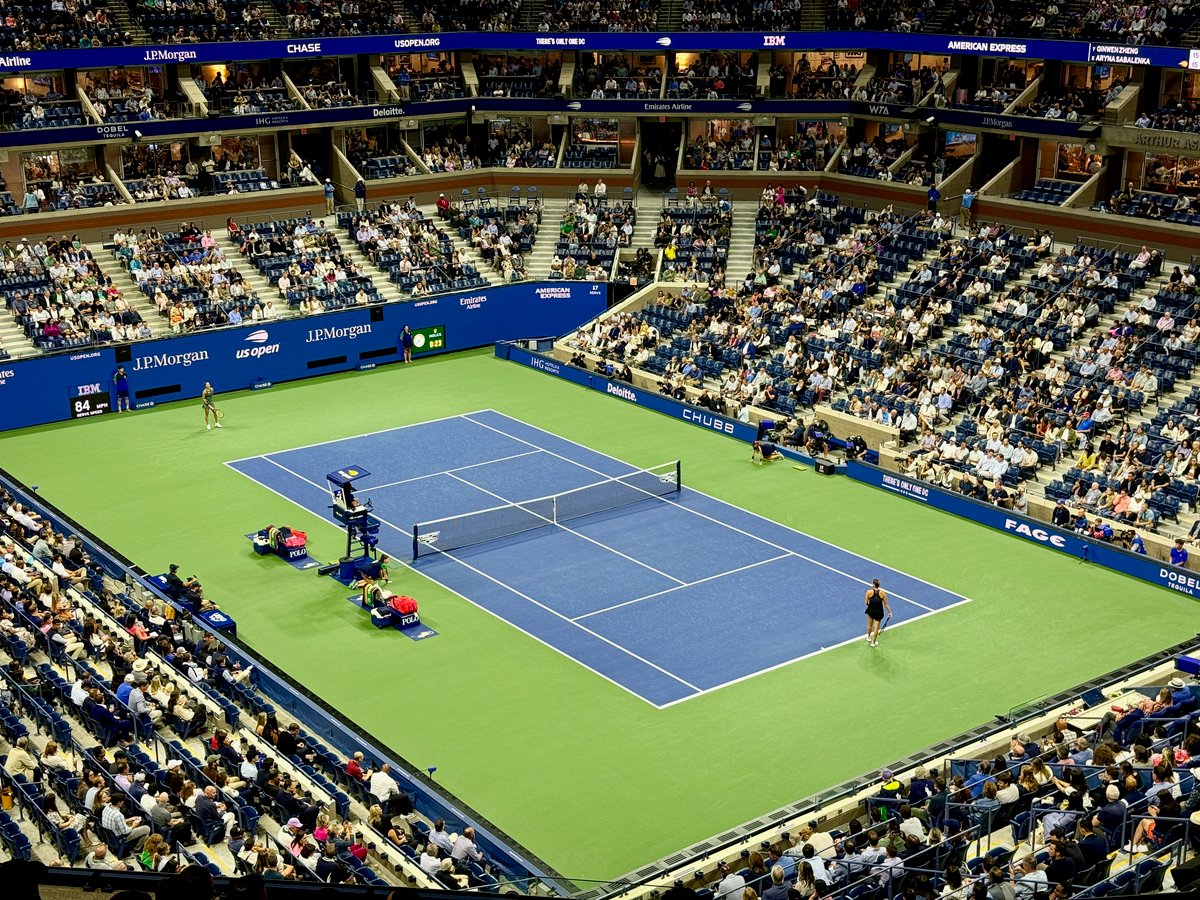
An 87-minute tennis match just rewrote the entire future of women’s sport. Not metaphorically. Literally. We have receipts.
On a June evening at Roland Garros, Aryna Sabalenka and Naomi Osaka took to the court for what was billed as a rare women’s night session—the kind of thing that happens roughly as often as a tennis ball grows wings. They played. The ball went back and forth. Someone won. And now, apparently, we are living in a new epoch.
The premise is intoxicating: two of the sport’s most magnetic players, under lights, in front of a crowd that actually showed up, playing tennis at a pace that made people remember why they paid for tickets in the first place. Eighty-seven minutes of competitive tennis has somehow become the Rosetta Stone for unlocking the entire commercial potential of women’s night sessions.
Let us be clear about what actually happened here. This was not a revolution. This was a match. A good match, sure. Two excellent players performing at a level that justified the primetime slot. But the immediate conclusion—that we have now discovered the secret formula for transforming women’s tennis scheduling—requires the kind of logical leap usually reserved for cryptocurrency investors and tech CEOs who have just discovered a chart going up and to the right.
The math is almost too perfect to be accidental. Take two players with genuine star power. Add darkness and artificial light. Subtract the afternoon doldrums when most people are still pretending to work. Multiply by the novelty of seeing women’s tennis treated as a main event rather than the appetizer course. The result: one unforgettable evening that will definitely, absolutely, certainly revolutionize the entire sport forever. Or at least until next Tuesday.
Here is what we are not saying: that Sabalenka and Osaka played badly. They did not. The tennis was sharp, the rallies had teeth, and the crowd energy was exactly the kind of thing that makes sports broadcasting executives check their viewership numbers obsessively. The problem is not the quality of the tennis. The problem is the assumption that 87 minutes of excellence is a scalable business model.
Women’s tennis has spent decades fighting for equal treatment—equal prize money, equal court time, equal scheduling respect. Those are fights worth fighting. But the current narrative suggests that one night session with two superstar players has somehow cracked the code on how to make women’s tennis commercially viable at night. It is as if we have decided that the entire sport’s viability hinges on whether Sabalenka and Osaka can be relied upon to produce must-watch tennis on demand, under lights, whenever broadcasters need a ratings boost.
That is not revolution. That is a dangerous kind of pressure dressed up as opportunity.
The real question no one is asking: what happens when Sabalenka plays Marketa Vondrousova in a night session? What happens when the draw sends two mid-ranked players to prime time? Does the night session suddenly become a terrible idea, or does it only work when the marquee names align perfectly with the scheduling gods?
Sport does not work that way, no matter how much we want it to. You cannot engineer stardom. You cannot guarantee that every night match will feature two players capable of delivering the kind of tennis that justifies pulling people away from their other options. Sometimes the 6 p.m. slot features a slog. Sometimes the marquee matchup is over in 54 minutes. Sometimes the best player in the world plays like someone who just woke up.
What Sabalenka and Osaka did accomplish in 87 minutes was prove that women’s tennis at night can work. That is genuinely valuable. It is also genuinely different from proving that it will work as a sustainable, scalable, repeatable business model that does not depend entirely on the whims of the draw and the form of the highest-ranked players.
The door they opened is real. The question is whether anyone has the infrastructure, the patience, and the commitment to actually walk through it. Not once. Not when the conditions are perfect and the stars align. But consistently, across seasons, across players, across the kind of unglamorous scheduling reality that makes up the actual calendar.
Until then, we have an 87-minute match that will be cited for years as proof that women’s night sessions are possible. And we have the sneaking suspicion that what we actually witnessed was not the dawn of a new era, but rather the exception that proves the rule: that women’s tennis can be magnificent when everything goes right, and that magnificence is worth paying attention to—not because it signals the future, but because it happened at all.