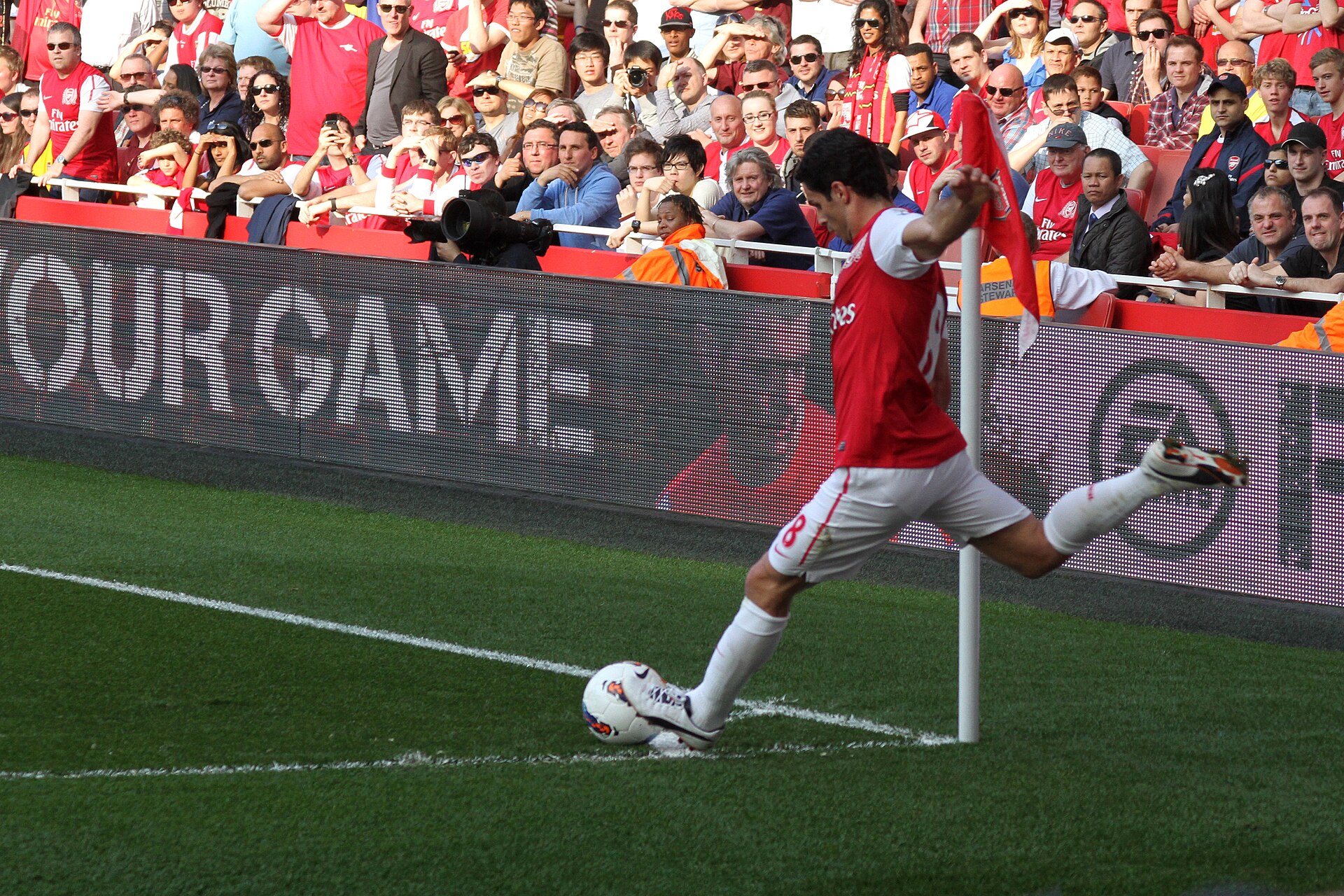
Mikel Arteta stood in the technical area on Wednesday night, and for a moment—just a moment—he allowed himself to believe that Arsenal had not merely won a football match, but rather altered the fabric of space-time itself. The club had beaten Atletico Madrid 2-1 on aggregate to reach their first Champions League final in twenty years. Twenty years. Two decades. A span of time during which the internet went from dial-up to instantaneous, during which smartphones became an extra limb, during which we collectively agreed that pineapple belongs on pizza. And through all of it, Arsenal had been waiting.
Arteta’s post-match commentary captured the true scale of this achievement: “We created history together.” Not “we won a semi-final.” Not “we advanced to the next round.” History. Actual history. The kind that gets taught in schools. The kind that archaeologists will excavate in three hundred years and say, “Look, here is the moment Arsenal reached a Champions League final.” Carbon-dated pottery shards with “COYG” scratched into them.
The Emirates Stadium crowd, we are told, provided an “incredible” atmosphere and energy. This is the language we now deploy for a semi-final victory. Not “good.” Not “enthusiastic.” Incredible. The same word we use for solar eclipses and the first images of black holes. Forty thousand people in North London, many of whom had paid between £150 and £400 for the privilege of standing in the rain, chanting in unison. Incredible. History. A monument to human achievement.
Let us pause here and acknowledge what has actually happened. Arsenal qualified for a continental club competition’s final. This is, objectively, a nice thing. It is something to be pleased about. The players performed well. The tactical setup worked. Atletico Madrid, a formidable opponent, was beaten. These are facts worthy of celebration.
But also: this is what football clubs are supposed to do. This is the entire premise. Manchester City has won the Champions League. Real Madrid has won it fourteen times. Liverpool, Milan, Bayern—these are organizations that have normalized continental success to the point where not reaching a final is considered a disappointment. Arsenal, by contrast, has elevated a semi-final victory to the status of a moon landing because the alternative—continued mediocrity—had become so familiar that any deviation from it feels revolutionary.
Arteta’s tribute to the players and fans is sincere, and sincerity is not the problem. The problem is that we have collectively agreed to treat the restoration of basic competence as if it were innovation. Arsenal fans have waited two decades for this. Two decades. They have watched rivals hoist trophies. They have endured the small-talk humiliations at work, the casual dismissals from opposition supporters, the slow erosion of expectation. And now, finally, they have something. A final. A chance. Not a guarantee, not a trophy in the cabinet, but a chance.
This is the absurdity that deserves recognition: we have built a culture of sports fandom so dependent on constant success that merely returning to the table at which the elite sit is treated as transcendence. Arteta did not say, “We won a semi-final.” He said they “created history.” The Emirates crowd did not celebrate a good result. They celebrated the restoration of their club’s right to compete.
There is something darkly funny about this. Arsenal will now face either Real Madrid or Bayern Munich in the final. One of those teams has won the Champions League more times than Arsenal has won anything in the last twenty years. The final itself will be a 50-50 proposition. They might lose. They probably will lose. And if they do, the narrative will shift instantly from “history created” to “history denied,” and the fanbase will return to the familiar ache of near-misses and what-ifs.
But for now, on this night in May, Arsenal has done something. They have beaten a good team. They have reached a final. They have given their supporters—patient, long-suffering, occasionally delusional—a reason to believe that the next chapter might be different from the last twenty.
And yes, that is worth celebrating. That is worth the atmosphere, the energy, the tributes from the manager. But let us not mistake the restoration of competence for greatness. Let us not confuse the return to the elite table with a seat at the head of it. Arsenal has not conquered Europe. They have not rewritten history. They have simply done what their resources, their stadium, their city, and their tradition have long suggested they should be able to do: compete at the highest level.
The real history will be written on the night they win the final. Until then, they have done something. It is worth something. But it is not everything. Not yet.