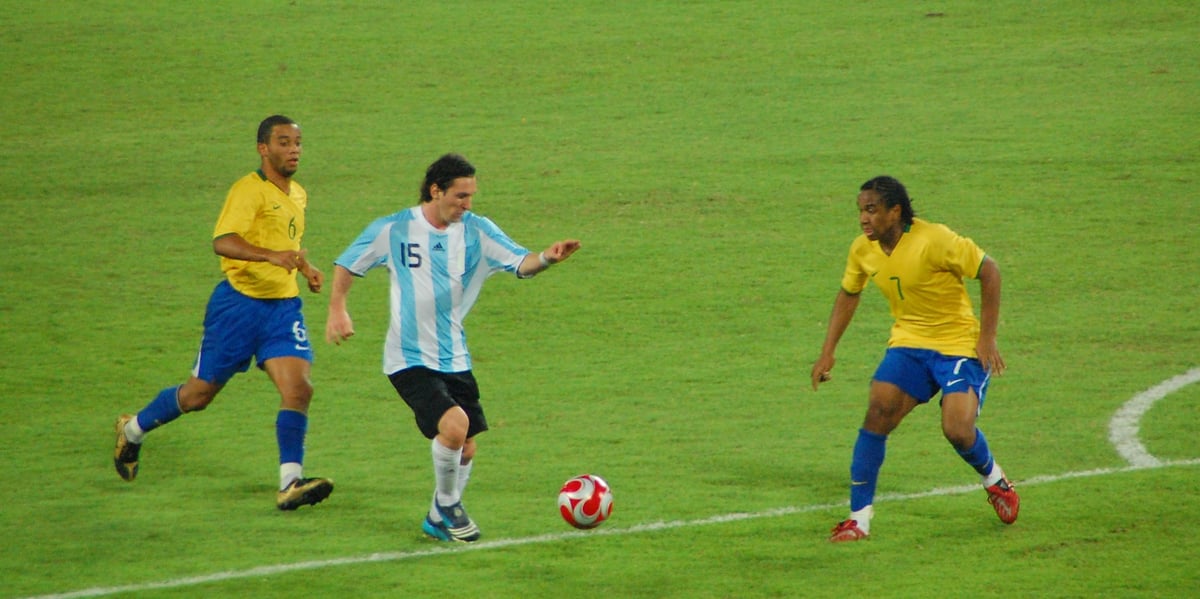
GENEVA — In an emergency session that ran fourteen hours past midnight, the United Nations Security Council voted unanimously yesterday to classify the Messi versus Ronaldo debate as a Level 5 Existential Threat to international stability, placing it above climate change, nuclear proliferation, and the ongoing crisis in artificial sweetener supply chains.
The resolution, drafted by a coalition of diplomats from Argentina, Portugal, and a surprisingly vocal contingent from Moldova, warns that the debate has metastasized beyond sport into a civilizational fault line that threatens to cleave the world into irreconcilable camps. Secretary-General António Guterres called an emergency press conference at 3 a.m., visibly exhausted, to announce that all UN member states must now declare formal allegiance to one footballer or face trade sanctions.
“We can no longer afford neutrality,” Guterres said, his voice cracking slightly. “This is not about statistics anymore. This is about who we are as a species.”
The escalation began three weeks ago when a Reddit thread comparing their career trajectories was cross-posted to X with the caption “Settle this once and for all.” Within seventy-two hours, the thread had generated 4.7 million replies, caused three data centers to overheat, and prompted the Prime Minister of Iceland to issue a formal statement declaring his nation’s allegiance to Messi “for the foreseeable future or until further notice.”
By May 28, the situation had deteriorated beyond recognition. Brazil’s government issued a non-binding but deeply felt opinion piece in the New York Times. France’s National Assembly held a closed-door session. Japan’s stock market dipped 0.3% on speculation that a major electronics firm’s CEO had made an off-hand Ronaldo comment at a shareholder meeting. The International Criminal Court opened a preliminary inquiry into whether prolonged exposure to the debate constituted a crime against humanity.
What made the situation genuinely alarming, according to UN analysts, was not the debate itself but the infrastructure it exposed. Nations discovered that their populations were willing to engage in sustained, rational argumentation about a single topic for the first time in recorded history. This terrified governments. If people could argue about Messi and Ronaldo with this much passion and evidence, what else might they start discussing?
The Swiss government, traditionally neutral on all matters, broke its 200-year silence to issue a statement: “We have examined both players’ records. We have consulted with our economists. We have prayed. We remain neutral, but we are less confident about it than before.”
Meanwhile, the actual footballers involved have remained conspicuously silent, which only intensified the crisis. A leaked memo from FIFA headquarters suggested that Messi and Ronaldo had both been advised by their publicists to avoid any comment whatsoever, on the grounds that anything they said would be immediately weaponized by their respective supporters and used as evidence in a debate that had now transcended sport entirely.
The economic consequences have been staggering. A venture capital firm in San Francisco announced it would no longer fund startups whose founding teams could not reach consensus on the question. Three marriages ended in divorce specifically because one spouse could not accept the other’s position. A major airline created separate cabin sections for Messi and Ronaldo partisans after a gate incident in Buenos Aires that authorities have declined to describe in detail.
Russia and the United States, finding themselves on the same side of the debate for the first time since 1989, briefly considered a joint statement before remembering they were supposed to be adversaries and retreated to their corners.
The UN resolution demands that by June 30, all nations submit formal position papers explaining their choice, complete with statistical appendices, philosophical frameworks, and notarized testimony from at least three credible witnesses. Failure to comply will result in expulsion from the General Assembly and a referral to the International Court of Justice.
Guterres concluded his address with a plea: “We have the chance to solve this. We have the data. We have the passion. We have the infrastructure. What we lack is the wisdom to accept that reasonable people can disagree on whether a player’s superior dribbling ability compensates for another player’s superior heading accuracy, and that this disagreement, while real, does not require the collapse of international law.”
It remains unclear whether anyone was listening. By the time he finished speaking, Twitter had already generated 40,000 new posts, each more confident than the last.