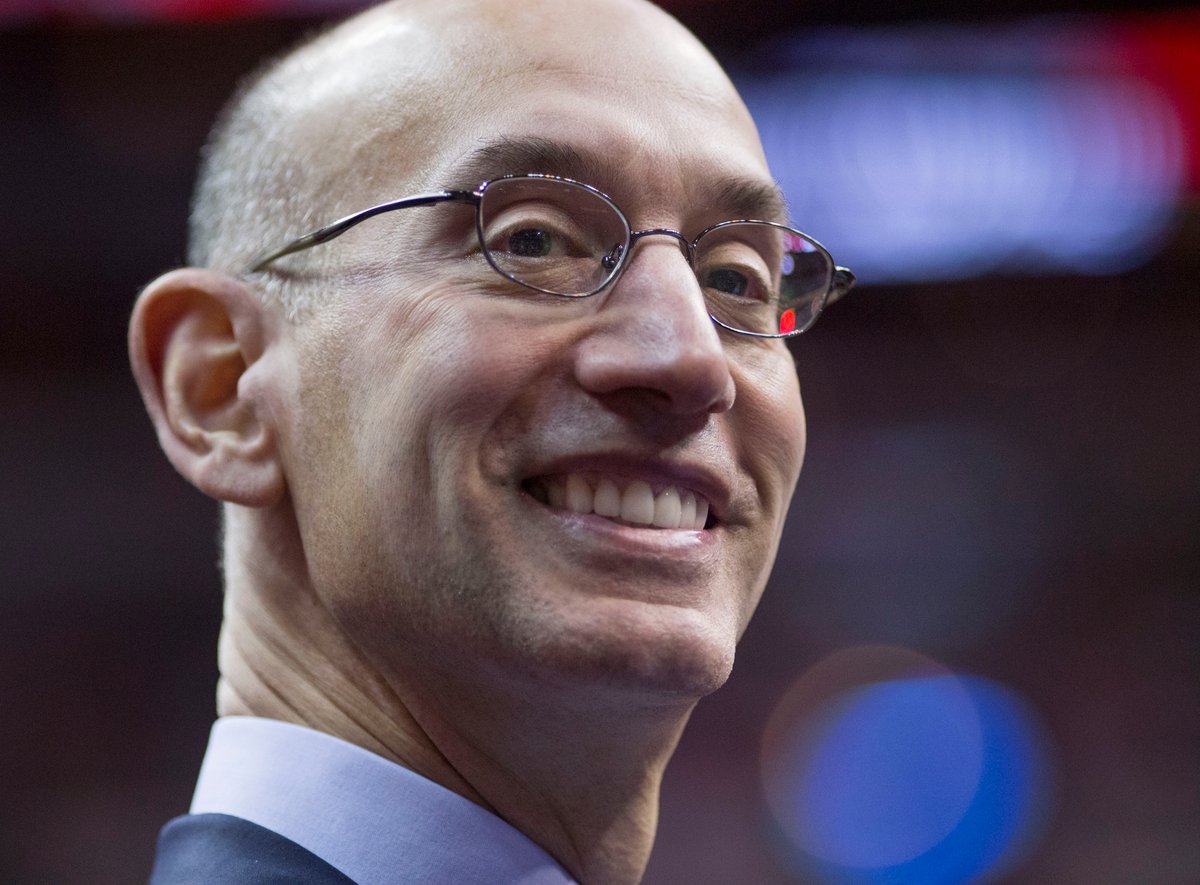
Adam Silver has issued a stern warning to basketball fans: stop running onto the court. The NBA commissioner, speaking with the gravity of a man who has just discovered that his league’s most pressing problem is not salary cap inflation or the slow death of mid-range basketball, but rather the terrifying prospect of a fan with a TikTok account sprinting past security, has declared that major sports events present an “enormous platform to do stupid things.”
The consequences, he warns, are “dramatic.”
Dramatic. Let that word sit for a moment. In a league where a single supermax contract now costs more than the entire GDP of some nations, where LeBron James’s agent negotiates his salary with the same leverage as a hedge fund manager shorting municipal bonds, where billionaires buy franchises the way normal people buy coffee—the commissioner’s biggest concern is a fan invasion.
Not the fact that players are increasingly owned by celebrities with more money than sense. Not the fact that Jalen Brunson makes more per year than the entire payroll of an Olympic basketball team. Not the fact that the league has become a financial instrument rather than a sport. No. The problem, according to Silver, is the fan who might run onto the court.
This is misdirection at its finest. This is the magician’s classic move: make everyone look at the left hand while the right hand is busy emptying your wallet.
Silver’s warning suggests that court invasions are now a genuine epidemic, a crisis of such magnitude that the league’s leadership must address it with the seriousness of a national security briefing. The reality? A handful of incidents at high-profile games, each one quickly resolved, each one generating exactly the kind of viral attention that makes the next person think: “Maybe I could be famous for thirty seconds too.”
But here is where Silver’s genius lies. By framing fan invasions as a career path—because let’s be honest, that is what “enormous platform” means to a generation raised on social media clout—he has accidentally created the very incentive structure he claims to be warning against. Every time a commissioner or a league official says “do not do this,” they are essentially saying “do this and you will be famous.” The platform is not being invaded. It is being weaponized by people who understand that five seconds of chaos on live television is worth more than five minutes of boring basketball.
Meanwhile, the real absurdities continue unabated.
Ownership has become a status symbol for the mega-wealthy, a way to say “I am so rich that I can afford to own a professional sports team and meddle with it constantly.” Celebrity owners bring celebrity chaos: they fire coaches via Twitter, they make trades based on vibes, they turn franchises into extensions of their personal brands. The court invasion is a symptom of a league that has lost its moorings, not the disease itself.
Player salaries have reached such stratospheric levels that the concept of “value” has become meaningless. A max contract is no longer a reflection of what a player is worth to the team; it is a reflection of what the collective bargaining agreement allows. The salary cap is a fiction designed to protect owners from themselves while maintaining the illusion of competitive balance. Silver could have warned fans about the absurdity of these financial arrangements. Instead, he warned them about running onto the court.
The irony is exquisite. The NBA is a league built on spectacle, on the idea that these athletes are larger than life, that the games matter in a way that transcends sport. And then, when a fan tries to become part of that spectacle—when they try to insert themselves into the narrative—the league treats it as a violation, a breach of the sacred boundary between performer and audience.
But that boundary has already been erased. Players are influencers. Owners are celebrities. Coaches are brands. The only people who are not allowed to participate in the spectacle are the fans themselves, the ones who actually pay for tickets and jerseys and merchandise and streaming subscriptions.
Silver’s warning is not really about safety. If it were, the league would have implemented the kind of security measures that actually prevent invasions rather than issuing vague threats about “dramatic consequences.” No, the warning is about control. It is about maintaining the illusion that the league is in charge, that the carefully orchestrated product being sold is not subject to the chaos of human behavior.
The consequences for running onto the court? Arrest. Lifetime ban. Legal liability. These are indeed dramatic. But they pale in comparison to the consequences of owning an NBA team: you get to make decisions that affect millions of people, you get to spend billions of dollars on a vanity project, you get to be famous forever.
If Silver really wanted to warn fans, he would warn them about the real career path available in the modern NBA: become rich enough to own a franchise and destroy it from the inside. That is the genuine epidemic. That is the platform being abused. That is the stupid thing that nobody is talking about.
But instead, we get warnings about court invasions. The commissioner has spoken. The message is clear: do not run onto the court. Everything else is fine. Keep paying. Keep watching. Keep pretending that the league you love is still about basketball and not about the endless accumulation of wealth by people who already have more money than they could spend in ten lifetimes.
The court is sacred. The salary cap is not. The fan who runs onto the court will face dramatic consequences. The owner who ruins a franchise will get to buy another one.
Welcome to the NBA in 2026. Where the real invasions happen in the boardroom, and the commissioner is very concerned about the ones that happen on the hardwood.