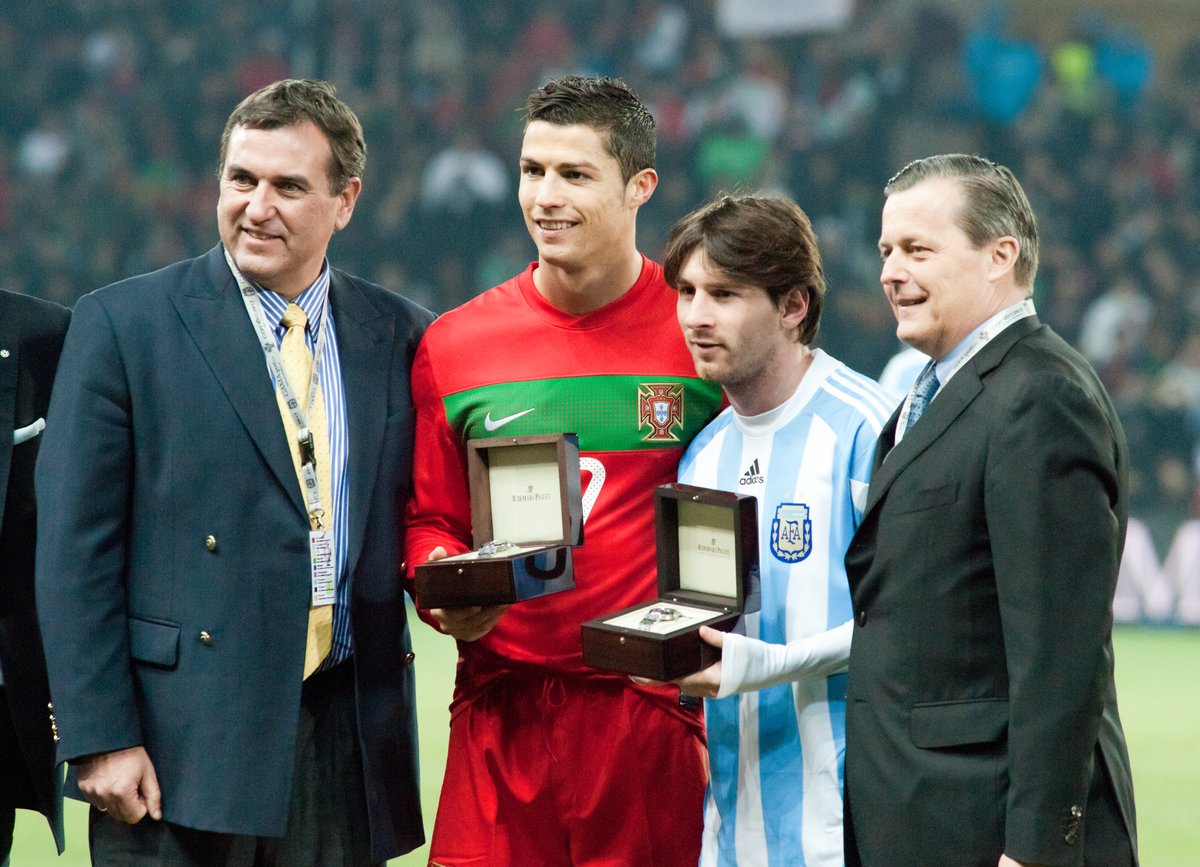
We have reached a point in human civilization where a photograph of Lionel Messi eating a sandwich is international news. Not because the sandwich was historically significant. Not because it solved a geopolitical crisis. But because Cristiano Ronaldo once ate a different sandwich, and therefore the comparative nutritional content of these two bread-based meals now matters to approximately eight billion people who have never met either man.
This is what the Messi-Ronaldo rivalry has become. Not a sporting contest. Not even a cultural phenomenon. A full-blown alternate reality in which every micro-decision, every Instagram post, every haircut, every alleged glance at a teammate is treated with the gravity of a UN Security Council resolution.
The original rivalry was pure. Two footballers of almost supernatural ability competing for trophies, awards, and the vague title of “greatest of all time”—a crown that exists only in the minds of people on the internet. They were separated by maybe half a percentage point of actual skill, which should have made for elegant, understated competition. Instead, it metastasized into something that would make a Cold War propaganda department blush.
Consider what we are now discussing. Last week, someone on Twitter (X, sorry) calculated that Messi had smiled 0.3 seconds longer at a Copa América press conference than Ronaldo had at a Saudi Arabia friendly. This was presented as evidence of psychological dominance. A smile. Measured in fractions of a second. Analyzed by people whose primary credential was having a strong opinion and a keyboard.
The fan theories have achieved a level of baroque complexity that would make conspiracy theorists weep. There are subreddits dedicated to analyzing whether Messi’s recent weight fluctuations indicate a mental shift in his approach to the game. There are TikTok creators who have built entire followings on the premise that every trophy presentation, every award ceremony, every casual hand gesture is part of an ongoing psychological warfare campaign. It is not. It is two men in their late thirties occasionally appearing at events.
But the media apparatus has no incentive to tell you that. Every outlet knows that a headline reading “Ronaldo’s New Haircut” will generate more engagement than actual tactical analysis. The photograph of Messi’s new boots becomes a referendum on his commitment to winning. A training session becomes evidence of a player’s mental state. The rivalry has become a machine that converts mundane human activity into clickable content, and it has been running at full capacity for nearly two decades.
What makes this genuinely funny is that both men are largely innocent of this madness. They play football. They compete. They have won trophies. They are both exceptional. But somewhere between their actual achievements and the public discourse, a third entity was created—a phantom rivalry that exists purely in the media ecosystem and the minds of fans who have confused passionate fandom with forensic analysis of a person’s breakfast choices.
The trophies themselves have become almost secondary to the spectacle. Winning a Ballon d’Or used to mean you were the best player that year. Now it means you have won a trophy that will be used as ammunition in a thousand Reddit arguments, each one arguing that the other player should have won it because of some metric that was invented specifically to support that argument. Goals per game adjusted for opponent strength? Assists per 90 minutes in the final third only? These statistics exist because someone needed to prove their preferred player was better, not because they reveal any meaningful truth.
The bizarre fan rituals have become their own form of performance art. There are people who track the number of times each player has been photographed with a specific type of ball. There are elaborate theories about why one player chooses to wear a certain brand of shin guard. There are spreadsheets—actual spreadsheets—tracking the exact angle at which each player’s foot strikes a ball, as if this is the hidden variable that will finally settle the question of who is better.
It is not. The question was settled years ago: they are both extraordinarily good at football. One won more Ballon d’Ors. One won a World Cup. Both have won numerous trophies. Both have been exceptional. This should be enough. It is not enough, because the ecosystem that surrounds modern sport does not reward sufficiency. It rewards obsession, argument, and the endless generation of new content.
So we arrive at June 2026, and we are still here. Still measuring. Still comparing. Still finding new and increasingly absurd metrics by which to declare one man superior to the other. A sandwich. A smile. A haircut. The rivalry that created an era has now become the era itself—a self-sustaining machine that requires no actual football to keep running, only the willingness of millions of people to care deeply about things that do not matter.
The truly masterful part is that both players have been complicit in none of this. They simply existed at the same time, played the same sport, and were very good at it. Everything else—the theories, the arguments, the statistical contortions, the bizarre fan rituals—was built on top of that simple fact by people who needed the rivalry to mean more than it does.
And it works. Every time. Because we cannot help ourselves.