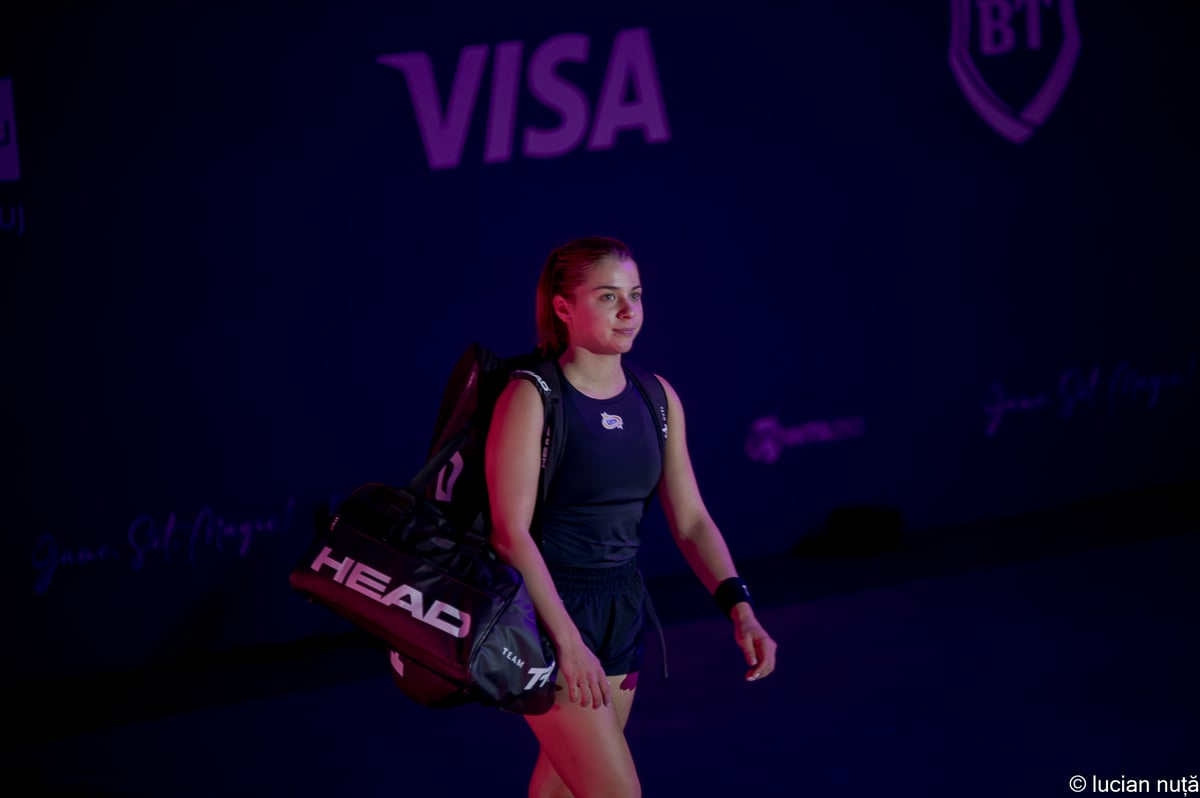
Here we are again. Another tennis qualifier has made an improbable run to a Grand Slam final, and somewhere in the sports media ecosystem, a narrative team is working overtime to find the one true artifact that explains it all. This time, it’s a tattoo. Not a training regimen. Not a coaching revelation. Not even a serve that suddenly found its range in the second week. A tattoo.
Maja Chwalinska, ranked 147th at the start of Roland Garros, has somehow sleepwalked through the draw and landed herself one match away from holding the Coupe des Mousquetaires. The tennis world is, predictably, scrambling to make sense of this. And in that scramble, someone noticed she has a small tattoo on her arm. Cue the existential breakdown of modern sports journalism.
The tattoo, we are told, is meaningful. It represents something she has overcome. It is a talisman. It is the physical manifestation of her journey through the darkest period of her life. It is, in other words, doing the narrative work that should belong to her forehand, her movement, her ability to break serve under pressure. Instead, a piece of skin art is being held up as the key to understanding how a 147th-ranked player is two hours away from a Grand Slam title.
Let’s be clear about what is actually happening here. Chwalinska is playing exceptional tennis. She is reading the court better than her opponents. She is constructing points with a patience that suggests she has either found a new tactical consciousness or has simply faced weaker competition than usual. Her serve is landing at the right speeds. Her backhand is holding up. These are boring, technical reasons for an unlikely run. They do not make for compelling television graphics.
A tattoo, on the other hand, does.
Tennis has always been a sport obsessed with the interior life of its players—their demons, their breakthroughs, their therapy sessions, their motivational mantras. Roger Federer’s grace. Serena Williams’s hunger. Novak Djokovic’s rigidity. We have built entire empires of understanding around the psychological profiles of players, as if tennis is ultimately a game played between the ears rather than on the baseline. And to some degree, it is. But there is a limit to how far this analysis should stretch.
When a qualifier makes a run, the instinct is to find the human story that explains the statistical anomaly. The problem is that statistical anomalies do not require supernatural explanations. They require luck, matchups, and the fact that on any given week, on any given surface, a player who is 147th in the world can play like she is 20th. This happens. It is not rare. But it is not narratively satisfying.
So we look for the tattoo. We look for the dead relative. We look for the injury overcome, the coach hired, the training method discovered. We look for anything that allows us to believe that there is a hidden variable, a secret ingredient, something that separates Chwalinska from the thousands of other qualifiers who flame out in the first round. Because if there is no secret ingredient, if she is simply having a good week and her opponents are having worse ones, then there is no story. There is just tennis.
Here is what is actually absurd about this moment: not that Chwalinska is playing well, but that the apparatus around her is so desperate to explain it through metaphor rather than mechanics. A tattoo is not a serve. It does not break down or improve with age. It does not require practice. It sits on her arm, unchanging, while her actual performance fluctuates based on a thousand variables that have nothing to do with ink.
Yet the tattoo will be mentioned in every commentary of her final. It will be the lead in a hundred think pieces about resilience and meaning-making. It will become, in the minds of casual viewers, the reason she won or lost. This is not Chwalinska’s fault. This is the fault of a media ecosystem that has decided that sport is most interesting when it is least about sport.
Tennis culture has always been prone to this kind of mysticism. The sport attracts players and commentators who are deeply invested in the psychological dimensions of performance. That is not inherently bad. But it has created a situation where a woman’s actual tennis ability—her court sense, her tactical flexibility, her ability to execute under pressure—is secondary to the narrative we construct around why she is playing well.
If Chwalinska wins the final, the tattoo will be part of the story. If she loses, the tattoo will also be part of the story—a symbol of how close she came, how the weight of meaning finally caught up with her. Either way, the tattoo wins. It cannot lose. It is the perfect narrative device because it is inert. It will not contradict you. It will not play badly. It will simply sit there on her arm, absorbing whatever meaning the moment demands.
The real question is not what the tattoo means. The real question is why we need it to mean anything at all. Why can’t a qualifier simply have a great tournament? Why must every unlikely run be explained through metaphysics rather than observed through the lens of actual tennis?
Maja Chwalinska will play her final. She will either win or lose. And somewhere in the media narrative, a tattoo will be credited or blamed. The absurdity is not that she has a tattoo. The absurdity is that we have decided it matters more than her serve.