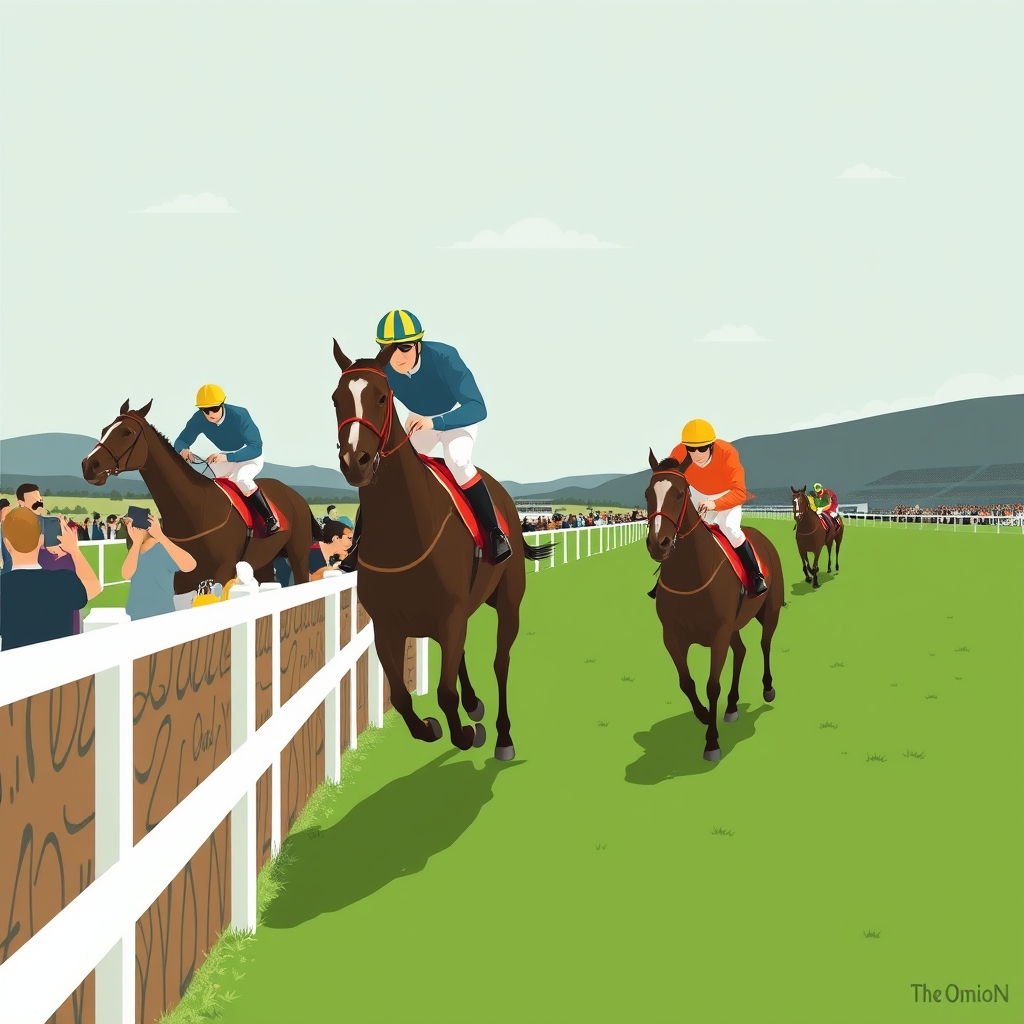
A horse named Lossiemouth extended her unbeaten record at Punchestown on Friday by five lengths. Somewhere in a parliament, a government majority narrowed by the same margin. This is not a coincidence. This is a warning.
We have reached a point in human civilization where the stability of the nation-state and the form of a thoroughbred have become indistinguishable. Both are judged on consistency. Both are measured by their ability to overcome obstacles that were not of their making. Both inspire betting syndicates to believe in destiny.
Lossiemouth’s dominance at Punchestown is not merely sporting excellence. It is a referendum on order itself. In a world where everything collapses—governments, currencies, attention spans—a horse that shows up and wins by five lengths is the only reliable institution left. She does not tweet. She does not triangulate. She does not hold a press conference to explain why her previous victory was actually a loss if you measure it the right way. She runs. She wins. She is unbeaten.
Meanwhile, Bob Olinger rode into retirement with victory in the Champion Stayers Hurdle, which is exactly what every democratic leader wishes they could do: leave on a high, with dignity intact, knowing they will never have to answer another question about their legacy. Olinger got out while the getting was good. He did not hang around for the inevitable decline, the podcast appearances, the Netflix documentary where former staffers reveal that he was always difficult to work with. He won and vanished. Democracy could learn from this.
The Punchestown Festival unfolded across three days of pure meritocracy—a concept so foreign to modern governance that it now exists only in equestrian sport. Gaelic Warrior raced clear to claim the Gold Cup because Gaelic Warrior was the fastest horse. Not because of gerrymandering. Not because of algorithmic suppression. Not because a foreign power spent £40,000 on Facebook ads. Because of speed and stamina and the absence of spin.
This is what haunts us about horse racing in 2026. It is honest in a way that nothing else is. The horse that runs fastest wins. The horse that cannot keep pace loses. There are no think tanks to reinterpret the results. There are no opposition politicians claiming the photo finish was rigged. The scoreboard does not lie because the scoreboard is simply a stopwatch.
Contrast this with the actual state of voting in the developed world, where the results of elections are now interpreted through seventeen different analytical frameworks before anyone knows what actually happened. We have spin doctors and counter-spin doctors and meta-analyses of the spin. We have exit polls that contradict the results, which contradict the recount, which contradicts the court order. We have citizens who watched the same election night and left believing in two entirely different outcomes.
Lossiemouth, by winning by five lengths, has inadvertently exposed the core failure of modern democracy: we no longer trust the scoreboard. We no longer believe that the fastest horse won. We believe that the race was fixed, or that the rules were unfair, or that the track was sloped in someone’s favor. We have weaponized doubt until doubt itself has become the only consistent winner.
The Punchestown Festival reminds us that there was once a time when humans gathered to watch something happen and simply accepted what they saw. The horse crossed the line first. The crowd cheered. The betting slips were cashed or burned. It was over. It was real. It required no further interpretation.
But we have moved beyond such simplicity. We have evolved into a species that can watch Lossiemouth win by five lengths and still find three reasons to believe the result should be contested. We see Gaelic Warrior claim the Gold Cup and our first instinct is to check Twitter to find out what we are supposed to think about it.
This is the true dystopia of modern voting: not that the wrong person wins, but that we can no longer agree on what winning means. A horse wins because it runs faster. A government wins because it received more votes. These are identical statements. Yet one is accepted without question while the other is now the subject of international litigation.
Lossiemouth stands unbeaten at Punchestown. Democracy stands unbeaten at nothing anymore. It just stands, confused, waiting for someone to tell it what to think about its own results. The horse knows better. The horse simply runs.