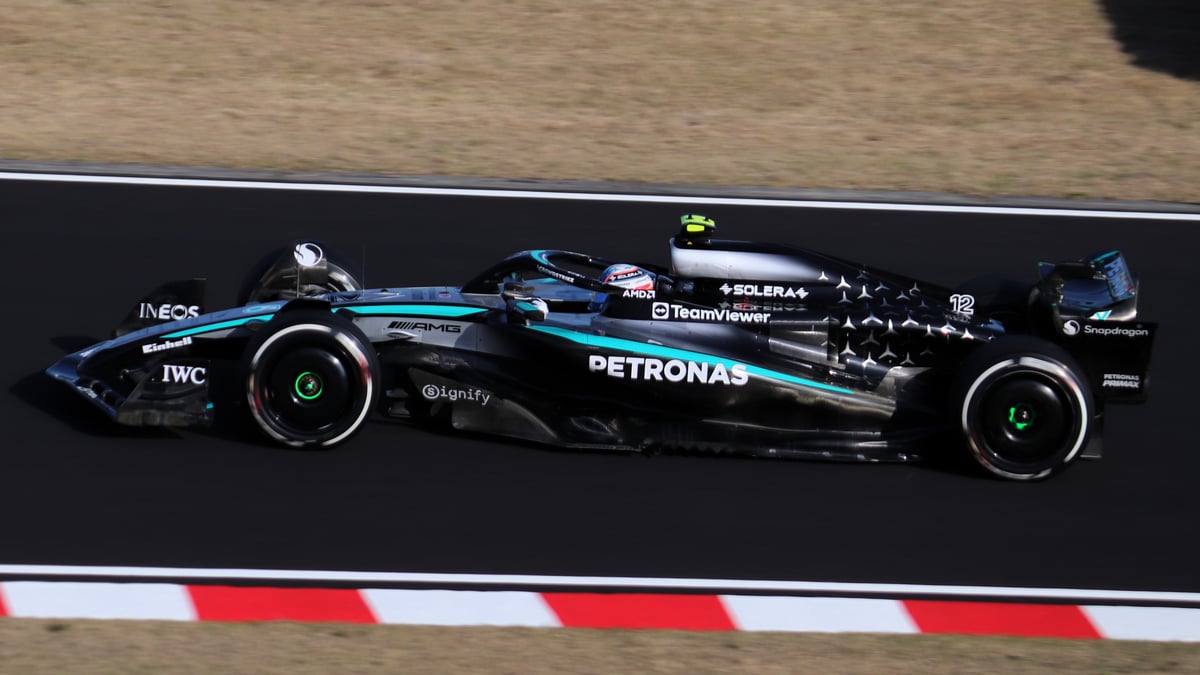
Kimi Antonelli won the Canadian Grand Prix on Sunday. This is a fact. It happened. He crossed the line first, collected the trophy, sprayed champagne, and presumably went about his evening like a man who had just done his job well. Somewhere in Montreal, life continued. The sun set. People ate dinner.
Meanwhile, the internet experienced what can only be described as a collective nervous breakdown.
George Russell retired from the race — a mechanical failure, the kind of thing that happens roughly seventeen times per season in Formula 1 — and the global response suggested that a beloved monarch had abdicated in disgrace. Social media transformed into a Victorian funeral parlor. Journalists who cover sport for a living began drafting eulogies. Mercedes team principals gave statements that read like they were announcing the end of a dynasty rather than the end of one race.
The irony, of course, is exquisite.
Antonelli’s victory — his second consecutive win, which is objectively significant and the sort of thing that builds a career — arrived wrapped in asterisks and footnotes. He won because his teammate broke. The narrative became not “Antonelli is driving brilliantly” but rather “Russell’s absence made this possible.” It is as though the media had collectively decided that Antonelli’s achievement could only be legitimate if it were somehow diminished by circumstance. A win without a worthy opponent is not really a win. It is a gift. It is luck. It is not the kind of thing you celebrate on its own merits.
Russell’s retirement, by contrast, became the story. The real story. The one that mattered. Because in modern sports discourse, failure is always more interesting than success, and loss is always more poignant than victory. A car breaking down is a tragedy. A driver executing perfectly is merely the expected outcome.
This is not new. This is how we have collectively agreed to feel about sport. We want our heroes to suffer. We want our champions to be tested by adversity. We want the narrative to be complex, layered, tinged with melancholy. A clean win feels cheap. A clean win feels like it is missing something essential — the element of struggle, the sense that greatness was hard-won rather than handed over.
Antonelli will remember Montreal as the place where he won twice. Russell will remember it as the place where his car failed him. One of these men will feel satisfied. The other will feel robbed. And the global audience, having invested its emotional energy almost entirely in the second narrative, will feel like Russell’s retirement was somehow more significant than Antonelli’s victory. This is backwards. This is absurd. This is exactly how we prefer it.
The comedy is that nobody seems to notice. The same outlets that celebrated Antonelli’s first Canadian win as a breakout moment now treat his second as a footnote to Russell’s misfortune. The narrative has shifted not because the facts have changed but because the facts were never really the point. The point was always the drama, the chaos, the sense that something was being taken away.
We do not actually want our champions to win cleanly. We want them to win despite everything conspiring against them. We want their victories to feel earned through suffering, even if that suffering belongs to someone else. Antonelli’s win is valid. It is legitimate. It is impressive. But it will never be as interesting as the story of what Russell lost.
This is the absurdity that sport offers us: the simultaneous elevation and diminishment of excellence. Antonelli crowned king. Russell mourned as a fallen prince. Both narratives true. Both narratives ridiculous. Both narratives exactly what we asked for.