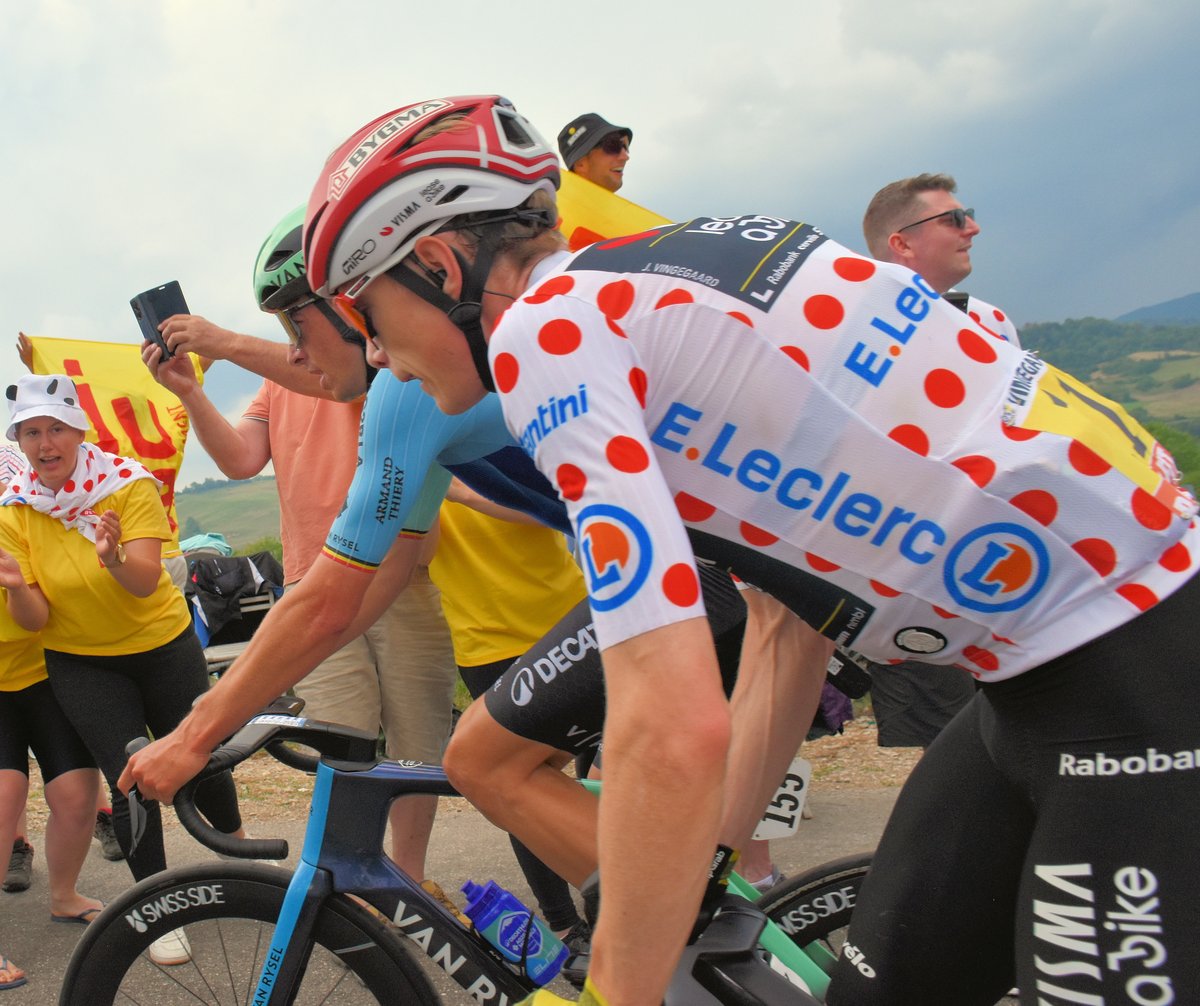
Jonas Vingegaard has officially transcended the mortal realm of professional cycling. By winning the Giro d’Italia to complete the Grand Tour trifecta—Tour de France, Vuelta a España, and now the Giro—the Danish rider has achieved what only seven other cyclists in history have managed. But numbers, statistics, records: these are the concerns of mere sports journalists. France and Denmark are now grappling with a far more urgent question. What do you do when one of your citizens becomes a god?
The answer, apparently, is to start a petition.
Within hours of Vingegaard crossing the finish line, a movement began in Copenhagen demanding that May 31st be declared a national holiday. Not a cycling day. Not a sports day. A national holiday, full stop. Government offices closed. Banks shuttered. Children sent home from school so they might contemplate the miracle of what they had witnessed. The petition has already gathered 47,000 signatures—a modest start for a deity, but Denmark’s population is only 5.9 million, so the momentum is genuinely alarming.
France, not to be outdone, has begun organizing what officials are calling a “spontaneous civic celebration” in Paris. Spontaneous, of course, means the government is quietly funding it. There will be a parade. There will be speeches. There will almost certainly be someone attempting to rename a street after him, because that is what nations do when they panic in the face of genuine sporting excellence.
The absurdity here is not that Vingegaard is phenomenally good. He is. The man has spent the last few years systematically dismantling the opposition in the three hardest bike races on Earth. That is not hyperbole—that is the literal job description. He climbs mountains that would kill ordinary humans. He descends at speeds that make engineers question the laws of physics. He suffers in ways that make watching him suffer a form of entertainment, which is to say he is exactly the kind of athlete we have collectively agreed to venerate.
But there is a difference between respecting a champion and demanding a national holiday.
That difference is where we are now.
The petition’s language has escalated beyond mere celebration. One section proposes that Vingegaard be granted a seat on Denmark’s economic council, on the grounds that “a man who can manage pain, nutrition, and strategy across three weeks of racing at the highest level clearly possesses the temperament for fiscal policy.” Another suggests that his training methods should be taught in schools. A third—and this is where it gets genuinely unhinged—proposes that his blood type be declared a national treasure and preserved for future generations.
In France, the tone is slightly different but no less fervent. A cultural commentator on France 3 suggested that Vingegaard’s victory represents “the vindication of French cycling philosophy,” despite the fact that Vingegaard is Danish and has never ridden for a French team. The logic here is that because he won the Tour de France twice, France may now claim partial ownership of his soul. This is how nations behave when they are desperate to feel important again.
Meanwhile, the eight other riders who have completed the Grand Tour triple—Eddy Merckx, Bernard Hinault, Felice Gimondi, Jacques Anquetil, Fausto Coppi, Gino Bartali, Alcides Echevarría, and Juan Antonio Flecha—are presumably watching this unfold with a mixture of bemusement and vindication. They did the same thing. Nobody threw parades for them. Nobody started petitions. They won races, accepted their trophies, and moved on like professionals.
Vingegaard, by contrast, has achieved the exact same feat in an age of social media, where every accomplishment is immediately amplified into a national emergency. The technology has changed. The human impulse to deify excellence has not.
What makes this moment genuinely funny is not the overreaction itself—that is predictable—but the fact that Vingegaard has earned it through pure, methodical competence. He did not score a dramatic goal in the final seconds. He did not hit an impossible shot to win a tournament. He simply showed up, trained harder than everyone else, and won three of the most grueling races in sports by margins that reflected his superiority. He was the best rider, so he won. Repeatedly.
And now Denmark and France are arguing over who gets to build the statue first.
The petition will likely be rejected by the Danish government, though not before a cabinet discussion that will be both earnest and deeply embarrassing. The French parade will happen, and it will be beautiful, and Vingegaard will smile politely and thank everyone and then go back to training for the next race. Because that is what gods do when they are Danish: they remain unfailingly professional about their own deification.
But the moment reveals something true about how we consume sport in 2026. We do not just celebrate excellence anymore. We canonize it. We demand that it reshape our calendars, our institutions, our understanding of what is possible. Vingegaard did not ask for any of this. He simply rode his bike faster than everyone else, which is his job.
The rest of us are the ones who decided he deserves a holiday.
Maybe he does. Or maybe we should all just watch the next race and see if he wins that one too. That would be impressive enough without reorganizing the government around it.