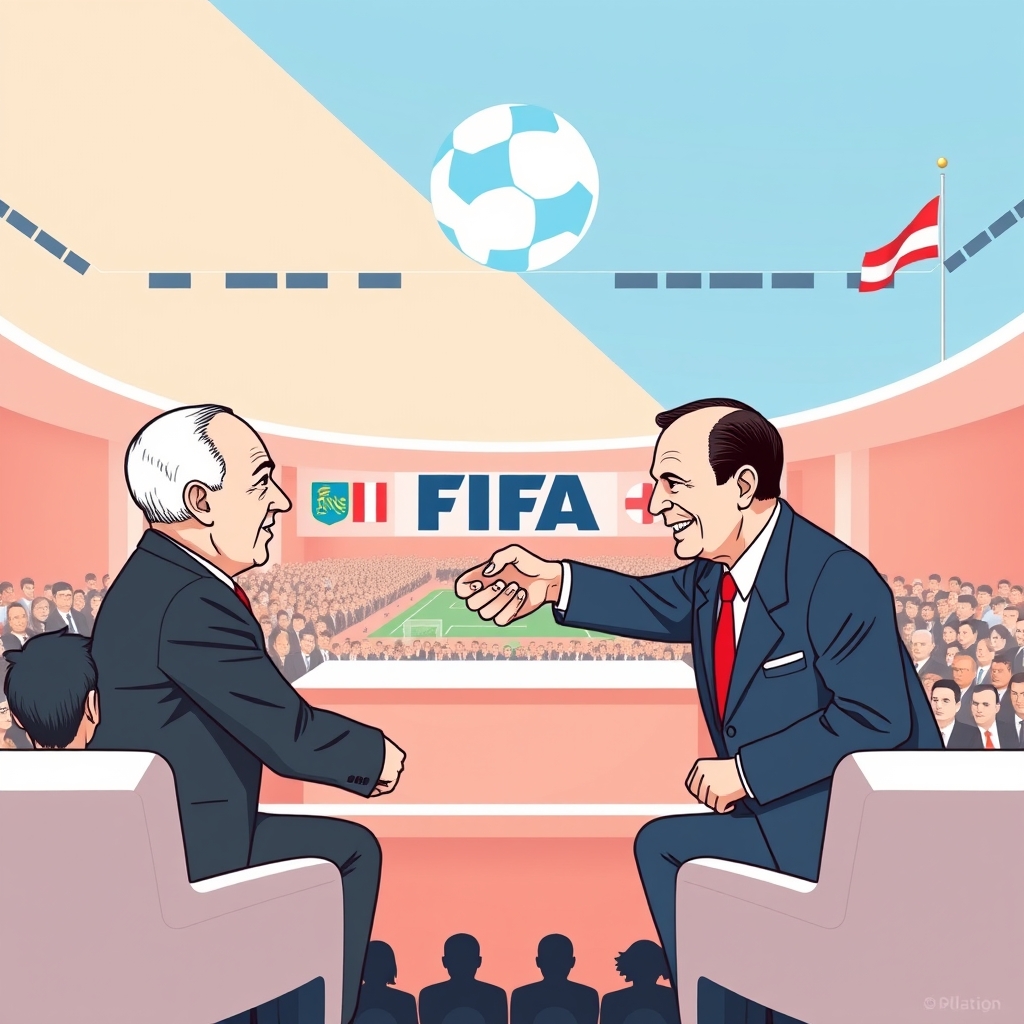
Gianni Infantino has solved it. After decades of failed diplomacy, UN resolutions, and actual politicians getting nowhere, the FIFA president has cracked the code to Middle East peace: a handshake. At a conference in Vancouver. Between people who have never met him before and probably wish they still hadn’t.
Let us pause here to appreciate the sheer audacity. Not a negotiated settlement. Not a framework for coexistence. Not even a strongly worded statement that FIFA cares very much about the situation. No—a handshake. Two hands meeting in the middle, probably awkwardly, probably while cameras flash and a room full of federation delegates pretend this matters.
This is what happens when a sports administrator mistakes the podium for the UN General Assembly. Infantino, who runs an organization that exists to move a ball around a field and extract television rights from the highest bidder, has apparently spent his spare time solving problems that have confounded world leaders, historians, and religious scholars for generations. The audacity is almost impressive. Almost.
The genius of the plan lies in its simplicity. A handshake is low stakes for everyone involved—except, you know, for the actual stakes of the conflict itself. If the handshake works, FIFA gets to claim credit for world peace and issue a press release that will run in three sports publications and zero actual news outlets. If it doesn’t work, well, they tried, and that’s what matters in the world of corporate social responsibility theater. The real world can keep burning; FIFA’s conscience is clean.
What makes this truly spectacular is the timing. We are in 2026. The world is not short on problems. There are wars, economic collapses, climate disasters, and tech companies harvesting human attention like it’s a renewable resource. And yet here is FIFA, an organization that cannot even prevent corruption within its own tournament-hosting process, stepping into the arena of international conflict resolution with the confidence of someone who has never been told no by anyone who actually mattered.
The Palestinian and Israeli representatives probably walked into that room expecting to discuss something, anything, related to football. Instead they got the sporting equivalent of your uncle at Thanksgiving suggesting that everyone just “talk things out” after three beers. Except your uncle doesn’t control billions of dollars in broadcasting contracts.
Let us also appreciate the implicit assumption: that two people who have never shaken hands before are the problem. Not history. Not geopolitics. Not decades of failed negotiations by actual diplomats. No—it’s that they haven’t met Infantino yet and performed a gesture of goodwill in front of the Uzbekistan Football Federation.
The FIFA Congress in Vancouver is not a peace summit. It is where football administrators gather to vote on rule changes, discuss tournament expansion, and congratulate themselves on how progressive they are while hosting tournaments in countries with questionable human rights records. It is the last place on earth where meaningful diplomatic progress happens. It is, in fact, exactly where you would go if you wanted to make a symbolic gesture that costs you nothing and looks good on social media.
And that is precisely why Infantino chose it. This is not diplomacy. This is a PR stunt wearing a suit and pretending to care. It is the corporate equivalent of a celebrity posting a black square and calling it activism. It is the sports world’s version of thoughts and prayers—emotionally satisfying to the person offering it, meaningless to anyone actually suffering.
The real scandal is not that Infantino tried. The real scandal is that in a world desperate for actual leadership, this is what passes for an attempt at it. Not policy. Not resources. Not even a genuine commitment to anything beyond the optics. Just a handshake, a photo opportunity, and a press release that will be forgotten by dinner.
But hey, at least FIFA tried. That is what matters, right? The trying. The gesture. The feeling that something was done, even if nothing actually was.
Football is supposed to unite people. That is the mythology we all accept when we watch the sport. But it unites them through the game itself—through shared passion, competition, and moments of genuine brilliance. It does not unite them through the desperation of an administrator who has confused a sporting event with a peace conference.
Infantino should stick to what he knows: expanding tournaments, negotiating television deals, and finding new ways to monetize the sport. The world’s problems are too serious for a handshake at a FIFA Congress. They always were.