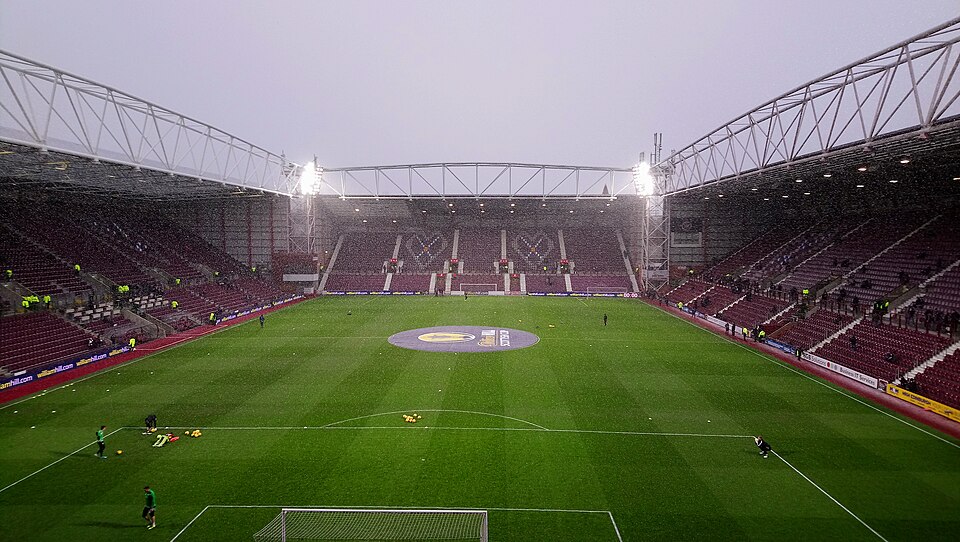
Hearts fans have spent the last twenty years constructing an elaborate psychological framework around their own mediocrity. It was not mediocrity, you understand. It was character. It was the dignified acceptance of a club’s proper station in the Scottish footballing hierarchy. It was humility in an age of excess. It was knowing your place.
Then Celtic beat Rangers last week, and that entire scaffolding collapsed.
Now Hearts must actually play in the Champions League qualifiers next season—their first appearance in that competition in two decades—and the existential dread has begun to set in. Not excitement. Not anticipation. Dread. Because for twenty years, Hearts fans have been telling themselves a very specific story, and that story does not include competing against clubs with budgets the size of small nations.
This is the curse of enforced humility. When you spend long enough telling yourself you are not good enough, you begin to believe it. You build an identity around it. You write songs about it. You develop a culture of self-deprecation so refined that outsiders mistake it for wisdom rather than what it actually is: two decades of coping mechanisms stacked on top of each other like a house of cards in a wind tunnel.
Hearts fans have become connoisseurs of their own disappointment. They have mastered the art of the graceful exit, the philosophical acceptance of defeat, the “well, we tried” shoulder shrug that somehow feels noble. They have convinced themselves that this restraint—this refusal to dream too loudly—is a virtue. It is not. It is survival. And now they must survive something else entirely: the possibility that they might actually belong somewhere they have been told they do not.
The Champions League qualifiers are not kind to teams that have spent two decades in the Scottish Premiership basement, telling themselves stories about character. Those qualifiers feature clubs that have been preparing for European football every single season. Clubs that have made it their baseline expectation. Clubs that do not need to reconstruct their entire sense of self-worth to justify playing at that level.
Hearts will enter those qualifiers as a team that has not played meaningful European football since the mid-2000s. They will face opponents who have been doing this for years. The gap is not just tactical or financial—though it is certainly that. The gap is psychological. Hearts players will be playing in a competition their club has spent two decades telling them they were not ready for. That is not a tactical disadvantage. That is a wound.
And yet, there is something almost beautiful about the absurdity of it all. Hearts are being forced, against their will and their carefully constructed mythology, to believe in themselves. They are being dragged into a competition they have spent twenty years convincing themselves they did not deserve. They will either rise to it, or they will confirm every doubt they have ever whispered to themselves in the dark.
There is no middle ground anymore. There is no comfortable acceptance of their place. They have been promoted—by circumstances entirely outside their control—into a position where they must actually try to win. Where they cannot hide behind the narrative of being a plucky underdog. Where they must confront the possibility that they are better than they have been allowed to believe.
That is terrifying. That is why Hearts fans are not celebrating. That is why there is dread instead of joy. Because once you stop telling yourself you are not good enough, you become responsible for proving that you are. And responsibility is always more frightening than resignation.
Hearts will play in the Champions League qualifiers next season. They will do so as a team still learning to believe in itself. They will do so as a fanbase still adjusting to the idea that humility was not a virtue—it was a prison they had built for themselves. And they will do so knowing that for the first time in twenty years, they cannot hide behind the story they have been telling.
They will have to actually see what they are capable of. That is the real existential crisis.