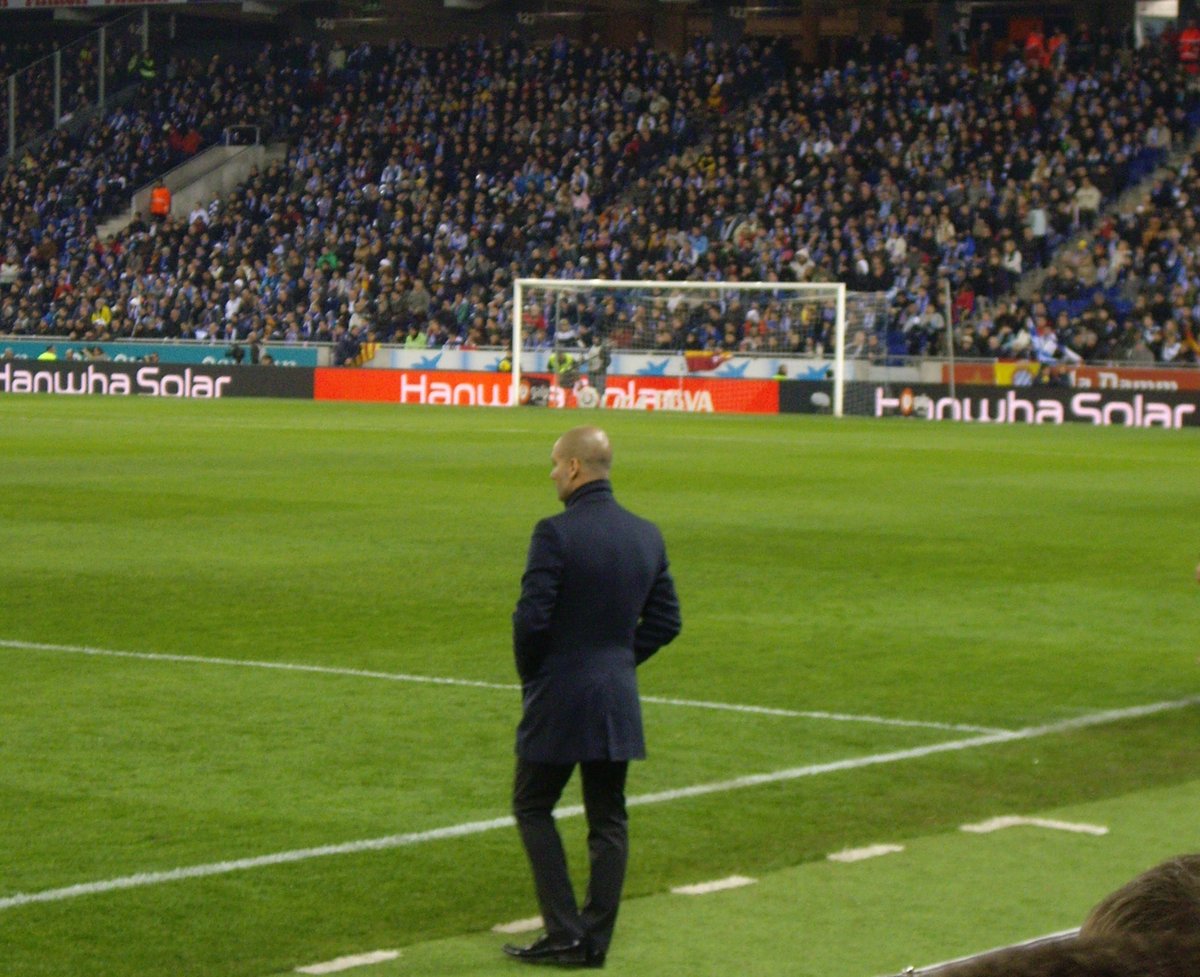
There is a moment in every dynasty when the machinery finally grinds to a halt. For Pep Guardiola and Manchester City, that moment arrived on the hour mark of his final game in charge—not with a bang, but with the sound of a man realizing that a decade of orchestrated perfection had been devoured by the very system that created it.
Guardiola, the tactical genius who had spent years performing the beautiful mathematics of football, finally cracked. Not because City lost a match—they had already lost something far more valuable: the plot.
Here is what modern football has become, distilled into one image: a manager of historic achievement, surrounded by players whose combined market value exceeds the GDP of small nations, unable to prevent the collapse of his own legacy because the infrastructure supporting that legacy has become too grotesque to sustain. The players cost so much that they must play. They must play even when playing breaks them. They must play even when the manager knows, with absolute certainty, that playing is the problem.
This is not a story about City’s decline. This is a story about what happens when you build a cathedral on the assumption that money is both the foundation and the roof.
Guardiola’s breakdown was not about tactics or fatigue or the natural cycle of dominance. It was about staring into the abyss of a sport that has lost its mind. City spent a billion pounds assembling a squad so expensive that every player on the pitch carries the weight of their own price tag like an anchor. Win, and you have justified the expense. Lose, and you have wasted a fortune. Play well, and you owe it to the shareholders. Play poorly, and you have betrayed the algorithm that predicted your success.
The absurdity reaches critical mass when you realize that Guardiola—arguably the greatest manager of this generation—could not save City from themselves because the club had become a machine that ate its own architects. You cannot manage a squad that exists primarily as a financial asset. You cannot inspire players whose value fluctuates with their Instagram engagement. You cannot build a dynasty on the principle that more money equals more goals, because at a certain threshold, the equation inverts. More money becomes more pressure. More pressure becomes more fragility. More fragility becomes the kind of moment where a man who has won everything sits on the sideline and finally admits that he has lost control of something far more important than a football match.
The irony is exquisite. City won three Premier League titles in four years because they had the resources to dominate. They built a machine so efficient that it seemed permanent. But permanence in modern football is a fiction sold to investors. What City actually built was a house of cards constructed from hundred-pound notes, and the wind that knocked it down was not a rival’s ambition or a tactical innovation—it was the simple fact that the human beings inside the machine were suffocating.
Guardiola’s tears were not about losing a game. They were about the recognition that he had spent a decade proving something that should never have needed proving: that with enough money, you can win football matches. And that in proving it so completely, so systematically, so relentlessly, he had helped create a version of the sport that had become fundamentally uninteresting to anyone who actually loved the game.
The glory did not end because City ran out of talent or because Guardiola lost his edge. It ended because the entire structure had become so absurd, so distended by cash and player valuations and shareholder expectations, that even genius could not sustain it. When the most brilliant tactical mind of the era breaks down on the sideline, it is not a moment of weakness. It is a moment of clarity. It is the moment when the system finally reveals itself for what it is: a mechanism for converting money into trophies, and in the process, converting football into something that looks like the sport but feels like a financial transaction.
Guardiola’s decade of glory did not collapse because he failed. It collapsed because he succeeded so completely that he proved the whole enterprise was hollow. City won more matches than any team in a generation. They dominated for longer than anyone thought possible. And in the end, all they had to show for it was a manager in tears and a sport that had become indistinguishable from a hedge fund with goal celebrations.
That is the real breakdown. Not Guardiola’s. Football’s.