Mikel Arteta spent eighteen months at Paris Saint-Germain in the early 2000s, and if you believe the narrative, he emerged as a tactical savant. The truth is slightly more complicated: he learned how to manage chaos by watching Pochettino operate in an environment where unlimited money collides with unlimited ego, then spent two decades applying those lessons to a club that treats consistency like a four-letter word.
Let’s be honest about what that PSG loan actually was. It was a masterclass in futility disguised as opportunity. Arteta arrived at a club drowning in ambition but chronically allergic to coherence. Paris had the talent to win the Champions League three times over, yet somehow managed to lose to teams with half the budget. It was the perfect training ground for a young player watching from the periphery: you learn more from watching a Ferrari crash than from riding in a Honda Civic that never breaks down.
Under Pochettino’s tutelage — and later, in the shadows of PSG’s rotating cast of tacticians — Arteta absorbed a fundamental truth about modern football management: talent alone is a lie we tell ourselves. Pochettino understood that you could have Mbappé, Neymar, and Cavani on the same pitch and still lose to a well-organized mid-table team if your midfield was having an existential crisis. Arteta watched this happen repeatedly, and something clicked. Not the winning part. The other part — the part where you accept that you cannot control everything, but you can control the system.
This is where the satire meets reality. Arsenal, under Arteta, has become a club that oscillates between “we are genuinely the best team in Europe” and “how did we lose to Nottingham Forest?” within the span of seventy-two hours. It is not incompetence. It is the natural state of a football club in 2026. The PSG loan prepared him for this the way a firefighter is prepared for a burning building: you know the fire is coming, you know you cannot stop it entirely, but you can at least understand the smoke.
Arteta’s tactical evolution from those PSG days is visible in how Arsenal now operates. He learned from Pochettino that pressing is not a tactic, it is a philosophy — a way of imposing your will on a game before it imposes chaos on you. But he also learned something darker: that even the most perfectly constructed press will occasionally face a striker who decides to become Pelé for ninety minutes, and your entire system collapses like a house of cards in a wind tunnel.
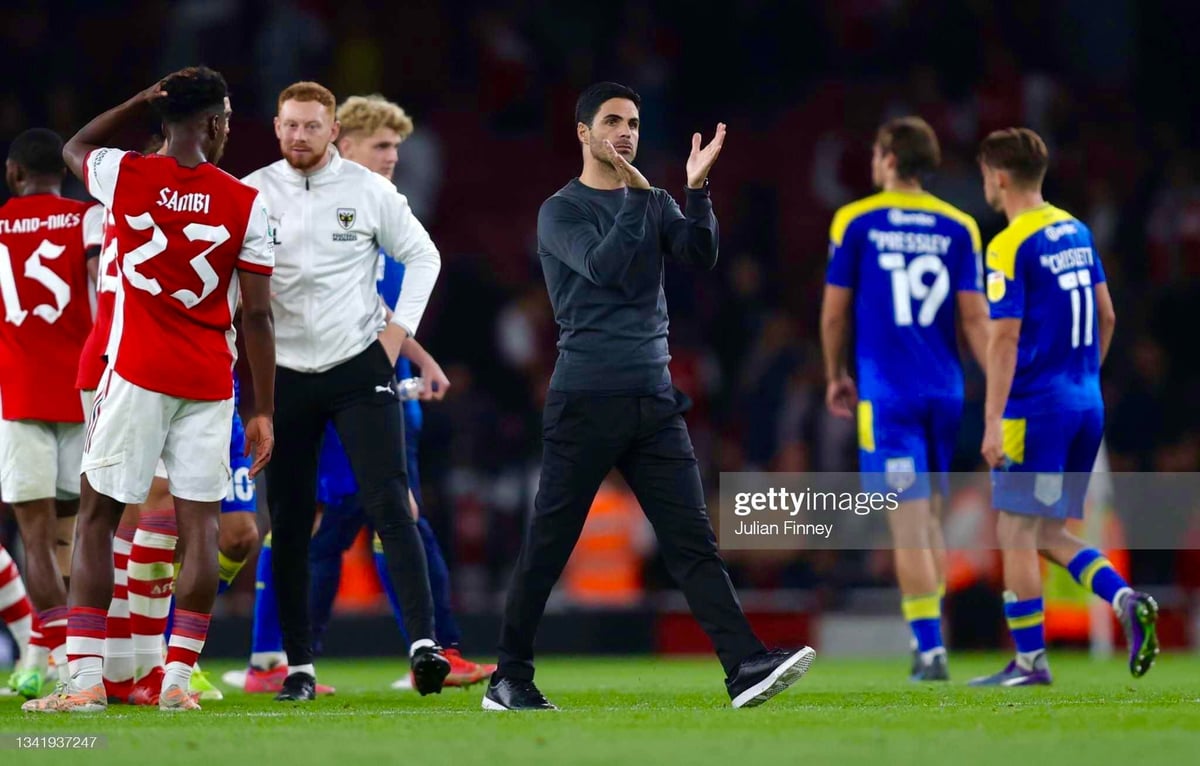
The brilliance of Arteta is not that he solved this problem. It is that he accepted it. Watch him on the touchline now, and you see a man who has made peace with the absurdity. The hand gestures, the theatrical frustration, the moments where he looks directly at the fourth official as if to ask, “Are you seeing this?” — these are not signs of a man losing control. They are the gestures of someone who learned at PSG that control is a myth, and the only thing you can do is commit fully to your system and hope the chaos breaks in your favor more often than it breaks against you.
Pochettino taught him tactics. PSG taught him acceptance. Arsenal has taught him that these two things are not in conflict — they are the same thing. A perfectly executed tactical plan executed against a team having a bad day is still a loss. A system that accounts for human unpredictability, that bends without breaking, that can absorb a moment of brilliance from an opposing forward without collapsing entirely — that is what Arteta built.
The loan spell to PSG was not the making of Arteta as a tactical genius. It was the crucible in which he learned to stop trying to be one. He learned to be something rarer: a manager who understands that football is not a game you win through perfect planning. It is a game you win by accepting that perfect plans exist only in PowerPoint presentations and the dreams of analysts who have never stood in a technical area and watched their entire strategy evaporate because a full-back decided to score a hat-trick.
Arsenal’s inconsistency is not a failure of Arteta’s system. It is the system working exactly as designed in a world where football has become too chaotic, too talented, too unpredictable to control. That is the real lesson from Paris. Not how to win. How to survive.