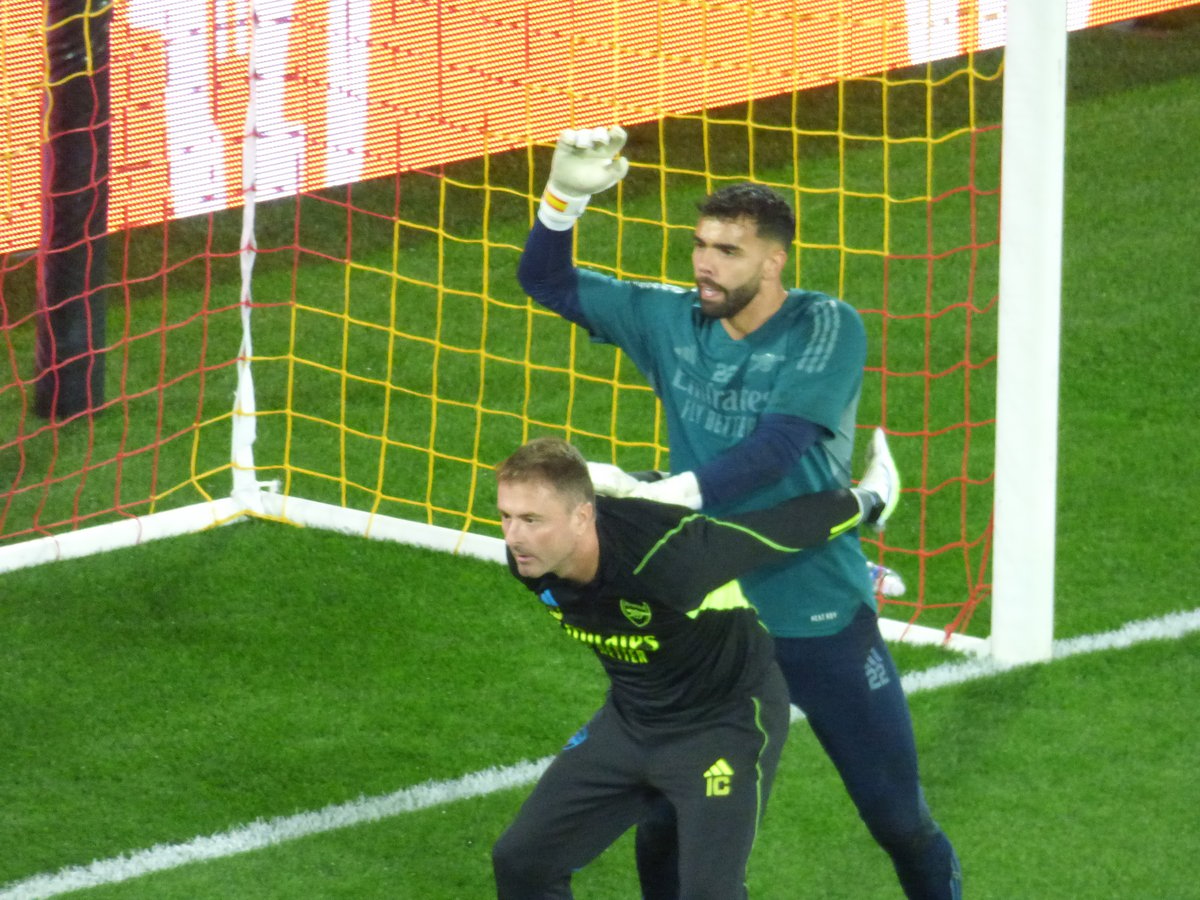
David Raya played for Southport twelve years ago. Southport. A club so non-league that their stadium probably doubles as a car park on Thursdays. On Saturday, he will stand between the sticks in a Champions League final. This is not a feel-good story anymore. This is a bureaucratic emergency that football’s governing bodies are only now beginning to understand.
The problem is not that Raya succeeded. The problem is what his success means for the entire pyramid of human achievement in professional sport.
For decades, we have operated under a simple hierarchy. Elite clubs sit at the top. Below them, a sensible gradient of competence descends through the divisions until you reach the non-league system, where players are assumed to be one injury away from their day jobs. This was the natural order. It was written in the rulebook not because anyone checked, but because it felt right. A goalkeeper at Southport was not an elite talent. He was a goalkeeper at Southport.
Raya has shattered this entire framework.
Consider what has actually happened here. A man played for a non-league club. That same man now plays for Arsenal. That same man will now compete for the most prestigious club competition on Earth. The logical conclusion—one that UEFA’s administrative staff are currently scrambling to avoid—is that non-league players are, by definition, elite talents waiting for discovery. The sorting system that football built was wrong. It was always wrong.
This realization has triggered what can only be described as a full-scale existential crisis in football’s upper echelons. If Raya was elite while at Southport and nobody knew it, how many other elite talents are currently playing for teams whose names nobody can pronounce? How many future Champions League winners are standing in goal for clubs that share facilities with Sunday league teams? The answer, by the mathematical logic that Raya’s rise has now established, is: all of them. Every single player in the non-league system is now, retroactively, an elite talent.
Football’s response has been predictable and absurd. Clubs have begun scouting non-league players with the intensity usually reserved for teenagers in Brazil. Agents have started representing goalkeepers from the Isthmian League as though they are the second coming of Gianluigi Buffon. The Premier League has quietly begun investigating whether it needs to restructure its entire talent assessment model. (It does. It absolutely does.)
The real scandal is not that Raya succeeded. It is that the sport spent years telling us that success was impossible from where he started. That the pyramid was meritocratic when it was actually just lazy. That a goalkeeper at Southport could not possibly be as good as a goalkeeper at a “proper” club, despite the fact that the only difference between them was the badge on their chest and the size of the stadium they played in.
What Raya has done is accidentally expose the arbitrary nature of sporting hierarchies. He has revealed that talent does not announce itself through the proper channels. It does not follow the designated pathway from academy to youth team to loan spell to established club. Sometimes it just shows up at Southport, keeps clean sheets for a decade, and then gets noticed because someone finally bothered to look.
Now every non-league player is living in a state of quantum superposition. They are simultaneously worthless and priceless, depending on whether a scout happens to watch their match on a Tuesday night. They are elite talents who have simply not yet been discovered by the system. The system did not fail them. The system failed to see them. The distinction matters, and it is ruining everyone’s ability to sleep at night in the offices at Nyon.
The irony, of course, is that Raya’s rise will not actually change anything. Scouts will not suddenly flood non-league grounds. Clubs will not restructure their recruitment entirely. Instead, football will do what it always does: tell the story of Raya as a miracle, a one-in-a-million exception, a fairytale that proves the system works. It will use his success to justify the continued existence of a pyramid that is fundamentally broken.
But now we know the truth. The pyramid was never about identifying talent. It was about controlling access to opportunity. Raya got through a crack in the system, and now the entire edifice is wobbling.
On Saturday, he will play in the Champions League final. By Monday, football will have convinced itself that this proves nothing about the thousands of players still stuck in the non-league system, waiting for their own crack to appear. The absurdity will continue. The hierarchy will hold. And somewhere in the Isthmian League, another goalkeeper will keep a clean sheet that nobody will watch.
Until, of course, they do.