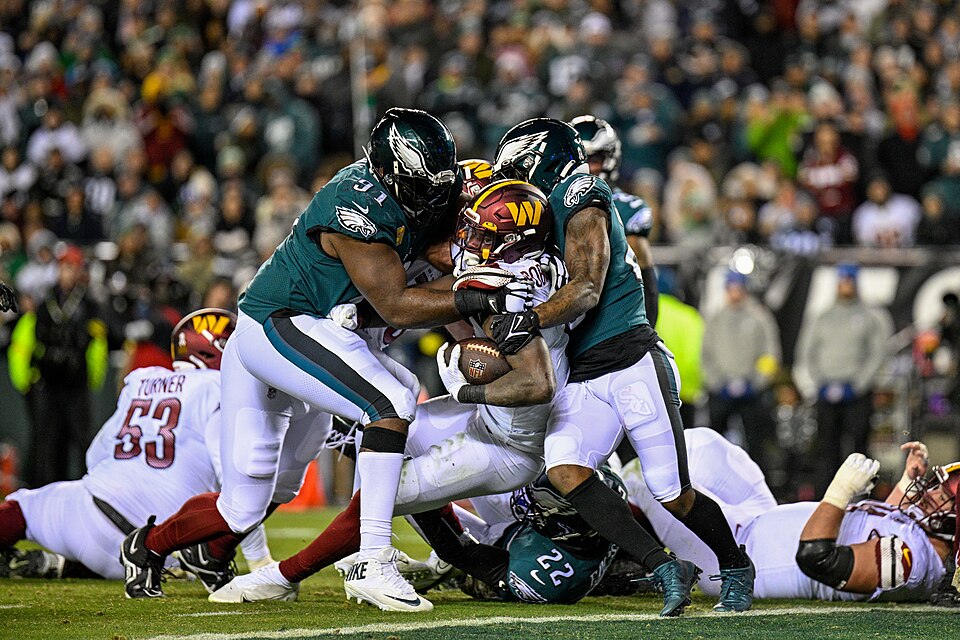
The Philadelphia Eagles are moving to London. Not permanently. Not yet. But for one game in 2026, they will board a transatlantic flight and play American football in a country that invented a sport where the ball is called a football but is primarily kicked with the foot, which has caused enough confusion already without adding Eagles in red jerseys to the mix.
This is not a small thing. This is an existential crisis masquerading as scheduling logistics.
The NFL has announced a record slate of international games for 2026, and the Eagles—a franchise with roots so deep in Philadelphia that their identity is literally tied to a city—will be among the teams exporting American football across an ocean that, for 246 years, has served as a protective moat between the NFL and civilisation. The league has decided that moat needs a bridge, and apparently the Eagles are the toll booth.
Fans have responded with the kind of measured, rational discourse you would expect from people who have invested their emotional labour in a sport designed to inflict controlled chaos on eleven men at a time. Some are devastated. Others are furious. A few have begun drafting strongly worded letters to the NFL that will be ignored with the same enthusiasm the league reserves for concussion research.
The argument, as presented by the league, is simple: global expansion. International markets. Monetisation of the sport in territories where American football is currently regarded the way Americans regard cricket—as something people do elsewhere, in the heat, while wearing inexplicable clothing. The NFL sees London and sees untapped revenue. Fans see their team being exiled to a country where the closest thing to a cheesesteak is a chip butty, and where the Eagles will play in front of 60,000 people who will spend the entire fourth quarter trying to figure out why there are so many stoppages.
What makes this particularly absurd is that the Eagles are not some expansion franchise or a team struggling for identity. They are a Philadelphia institution. Their fans have bled green for generations. The city has suffered through decades of playoff heartbreak and regular-season disappointment with the kind of loyalty that borders on masochism. To ask these people to accept their team playing in Tottenham, of all places, is to ask them to accept that the NFL views their emotional investment as fungible.
The league will argue that it is one game. Just sixty minutes of football, played on grass, in a stadium that will be configured to look more or less like every other NFL venue. The Eagles will return home. Life will go on. This is progress. This is the future of the sport.
Except it is not one game. It is a statement. It is the NFL saying that geography is negotiable, that home is a concept that can be renegotiated for profit, that a franchise’s relationship to its city is secondary to the quarterly earnings report. If the Eagles can be sent to London, then no team is safe. The Cowboys could end up in Tokyo. The Packers could be playing in Berlin. The Patriots could be—well, they already feel like they are in exile, so perhaps that would be poetic.
The real scandal here is not that the Eagles are playing in London. It is that we have all become so accustomed to the commodification of sport that this barely registers as unusual. A generation ago, moving an NFL game across the Atlantic would have sparked congressional hearings and op-eds in the New York Times. Now it is a press release and a scheduling conflict for East Coast fans.
The Eagles will play in London. They will probably win. Their fans will wake up at an ungodly hour to watch it, because that is what fans do—they suffer through whatever indignity the sport asks of them. The NFL will declare it a success. More international games will be announced. Eventually, there will be an entire division based in Europe, and Americans will have to explain to their children why their home team plays five time zones away.
This is not a crisis. It is not a civil war. It is simply the logical endpoint of a sport that has decided that tradition and geography are luxuries it can no longer afford. The Eagles are flying to London, and we are all just passengers on a flight we never booked.