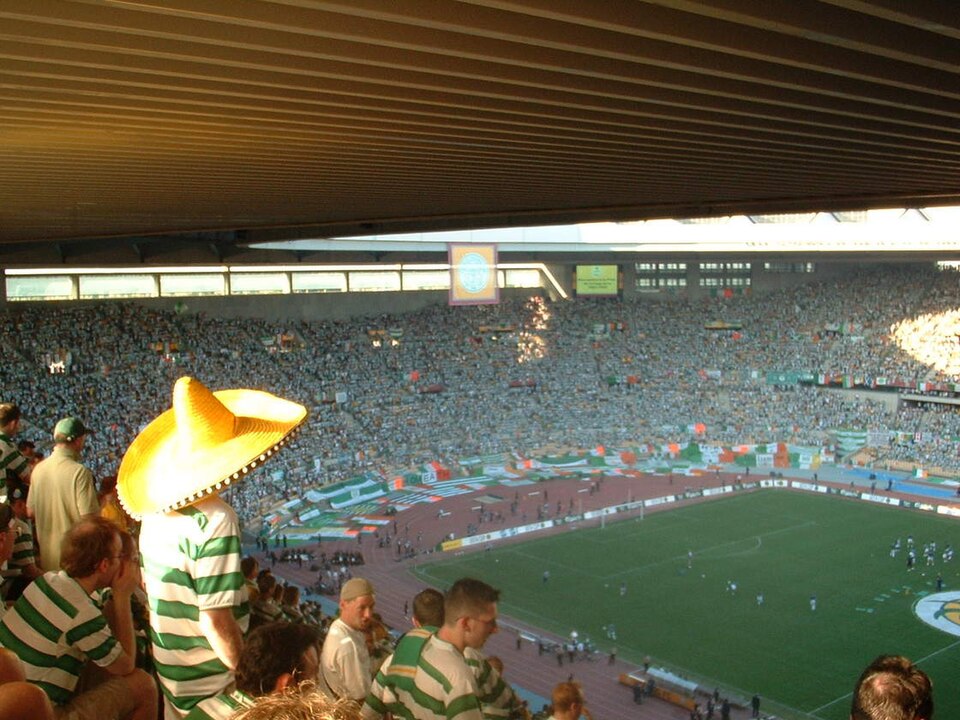
Glasgow’s east end has officially been declared a sovereign nation as of 3:47 p.m. on Saturday, after Celtic’s 3–1 demolition of Hearts secured the Premiership title. The declaration came not from any government body, but from approximately forty thousand fans who spontaneously decided that normal celebration protocols no longer applied.
What began as a standard postmatch gathering in the streets rapidly evolved into what witnesses are now calling the Glastonbury of football fandom—if Glastonbury had zero planning, infinite pyrotechnics, and a genuine belief that the laws of physics had been suspended by a 90-minute sporting event. Fans erected what can only be described as a temporary autonomous zone, complete with impromptu stages, coordinated chanting that achieved harmonic resonance, and a parade route that somehow managed to include every major street in the city despite nobody having announced a parade.
The celebration’s scale caught the attention of authorities, who, upon observing the sheer density of humanity and the volume of noise emanating from the east end, made the entirely reasonable assumption that a riot had broken out. Not a celebration. Not even an enthusiastic gathering. A riot. One that involved people dancing, singing, and occasionally—in what can only be described as a traditional offering to the football gods—pelting objects skyward with such frequency that the sky itself seemed to be raining bottles back down.
This is where the story shifts from “fan celebration” to “why did anyone think this was a good idea.”
Swat units arrived. Actual tactical units. Dressed for a siege. What they found instead was the most organized chaos ever documented: fans had somehow managed to create a festival atmosphere complete with unofficial merchandise stalls, impromptu food vendors, and what appeared to be a functioning sound system that nobody could quite locate. The SWAT teams, faced with the cognitive dissonance of encountering a “riot” where the primary weapon was enthusiasm and the secondary weapon was recycled glass, did what any reasonable tactical unit would do: they attempted to disperse the crowd using water cannons.
This did not work. In fact, it only made the celebration wetter and, if such a thing is possible, more celebratory. Fans treated the water cannons as an unexpected cooling system on a warm May afternoon, essentially turning a police dispersal tactic into an accidental public amenity. The bottles that had been aimed at the sky were now being aimed at the water cannons themselves, creating what can only be described as the world’s most hostile water fight.
By evening, Glasgow’s east end had established what appeared to be permanent civic infrastructure: barriers made of human bodies, chanting sections that had organized themselves into geographic zones, and a general consensus that the normal rules of urban conduct had been temporarily suspended in favor of a festival that nobody had planned but everyone seemed to understand the rules for.
The truly absurd part isn’t that fans celebrated. It’s that the celebration became so elaborate, so coordinated, so fundamentally joyful that it confused the authorities tasked with managing it. A SWAT team arrived expecting a riot and found instead what amounted to the world’s most enthusiastic street party—one that had somehow managed to generate its own governance structure, its own entertainment, and its own peculiar traditions (including the aforementioned bottle-tossing ceremony).
By the time the evening settled into what could charitably be called “controlled chaos,” the east end of Glasgow had essentially hosted an unauthorized festival that rivaled actual organized events in terms of attendance and atmosphere. The police, having discovered that water cannons are ineffective against pure joy, eventually stood down. The fans, having discovered that a Premiership title win could be turned into a three-day civic celebration complete with unsanctioned parades and invented traditions, showed no signs of slowing down.
This is what happens when a city’s football team wins and forty thousand people decide that the normal rules of celebration are insufficient. You don’t get a riot. You get a festival. You get traditions invented on the spot. You get a SWAT team standing confused in the middle of a street party, holding water cannons like they’re at a summer fair.
Glasgow’s east end, having declared itself an independent nation of celebration, appears to have no plans to rejoin the rest of the city anytime soon. The only question remaining is whether this becomes an annual tradition—a festival that erupts whenever Celtic wins, complete with its own unofficial merchandise, its own chanting sections, and its own understanding that the normal rules of urban conduct are, for a few glorious hours, entirely negotiable.