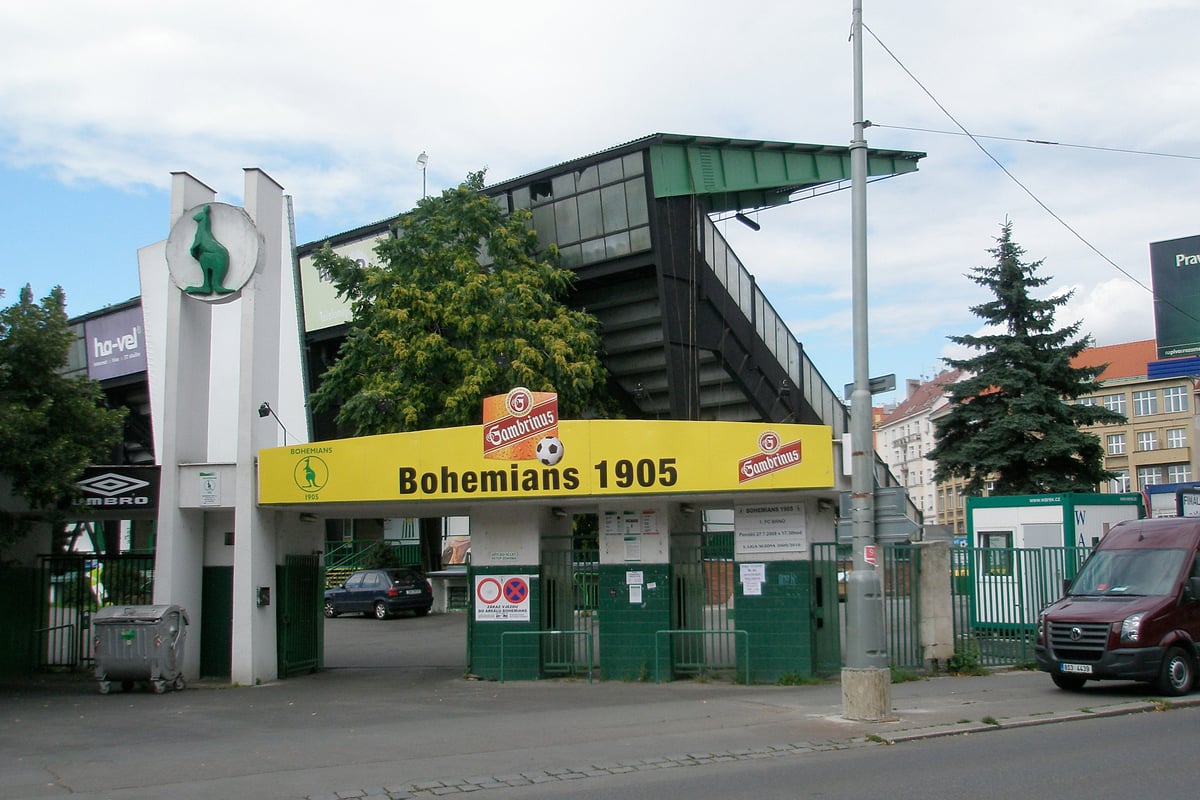
Bohemians 1905 has solved a problem that has plagued football for over a century: what to do with the people who show up every weekend, drink beer, and loudly declare they could do better than the professionals on the pitch. The answer, it turns out, is to let them try.
The Czech club announced this week that it will recruit supporters to form a C team that will enter the official Czech football league system next season. This is not a training initiative. This is not a community outreach program. This is actual competitive football, with actual standings, actual points, and actual consequences for showing up hungover on match day.
Let that sink in for a moment. Somewhere in Prague right now, a 47-year-old accountant who once scored a goal in a pub league is adjusting his expectations about what his Sunday afternoons might become. He is simultaneously terrified and vindicated. For twenty years he has been telling his friends that the Bohemians’ left back has no business being professional. Now he gets to prove it by attempting to mark him.
The beauty of this move is its absolute honesty. Most football clubs pretend their academy is about development, their youth programs about talent identification, their community schemes about social responsibility. Bohemians 1905 has cut through all of that. They are essentially saying: “We have a slot in the league system. We need bodies. You are here every match day. You have opinions about tactics. You think you know better. Congratulations. You now have the opportunity to be humiliated in an official capacity.”
This is what happens when the gap between fan and player becomes so aesthetically vast that someone finally asks the logical question: what if we just removed the gap entirely? What if we took the people screaming from the stands and put them on the pitch? Not as some feel-good exhibition. Not as a one-off novelty match. As a real team, competing for real points, facing real consequences.
The Czech football league system is hierarchical. The C team will compete at a lower level, which means they will face other teams of similar construction—likely other reserve squads, other amateur elevations, other experiments in the blurring of competitive sport and participatory fantasy. This is both better and worse than it sounds. Better, because they will not be immediately destroyed by a professional outfit. Worse, because they will still lose to other teams of fans who also think they know better.
There is something genuinely democratic about this. Not in the sense of equity or inclusion—though the marketing will certainly frame it that way. Democratic in the sense of: we are testing the hypothesis that everyone contains within them the ability to compete at organized sport. We are about to find out, in real time, with actual fixtures and actual scorelines, whether passion and conviction and twenty years of armchair analysis can substitute for actual training, actual fitness, actual tactical positioning.
The answer, statistically speaking, is no. But that is not the point. The point is that Bohemians 1905 has recognized that the modern fan does not want to be told their opinion is invalid. They want to be told their opinion has merit and then given an opportunity to prove it wrong themselves. It is the sporting equivalent of letting someone touch the hot stove.
What makes this truly revolutionary is not the logistics. It is the philosophical position it represents. For decades, the line between fan and athlete has been sacred. You sit there. We play here. You pay to watch. We get paid to perform. That boundary has eroded in other sports—social media has made athletes and fans neighbors on the same digital street—but in football, the pitch itself has remained a fortress.
Bohemians 1905 has knocked down that fence. They have said: the fortress is open. Come through. Bring your tactical theories and your match day anger and your conviction that you could do it better. Let’s see.
The results will be instructive, not because they will prove anything about football, but because they will prove something about the nature of confidence and the difference between knowing and doing. Every fan who shows up for that first match will understand, within fifteen minutes, why the professionals make it look easy. Every fan who quits after that first match will have learned something valuable about themselves.
And every fan who persists, who comes back for the second match and the third and the season-long slog, will have earned something that no amount of armchair analysis can provide: the actual experience of being wrong in public, on a football pitch, with a scoreline to prove it.
That is worth more than any academy program. That is worth more than any youth development scheme. That is the real revolutionary move: making fans confront the gap between what they think they are and what they actually are. On a pitch. In front of witnesses. With statistics.
Welcome to professional football, supporters. You wanted in. Now you are in. Let’s see if you were right.