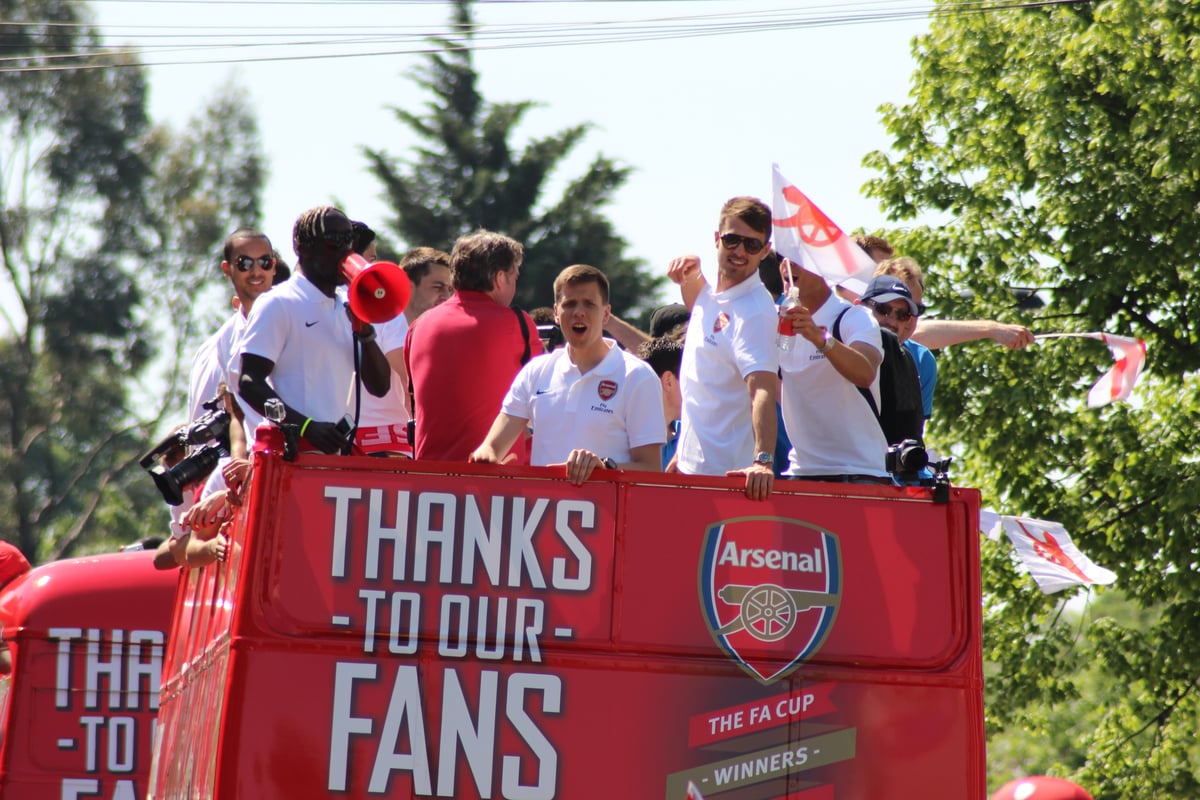
There is a special kind of cruelty in the modern football calendar that Arsenal fans are about to experience in real time. On Sunday, less than 24 hours after watching their Champions League final dreams evaporate in whatever manner European football has decided to break hearts this season, they will board an open bus and parade through London to celebrate winning the Premier League. This is not a metaphor for emotional whiplash. This is the literal schedule.
Imagine the scene: confetti cannons ready. Fans with signs that took three hours to make. The trophy polished. And somewhere in the crowd, a man named Derek who has already cried twice since Thursday evening, now forced to smile and wave while his voice cracks singing the club song. This is the Arsenal experience in 2026, where you are required to feel joy and devastation simultaneously, like a person trying to laugh and sob at the exact same moment.
The absurdity is not in Arsenal winning the league. That is perfectly normal. Arsenal have been good enough to win domestic titles. The absurdity is in the scheduling—the calendar’s insistence that a club should celebrate the achievement of an entire season while the wound from 48 hours ago is still actively bleeding. There is no time to process. There is no moment to sit with the failure, to understand what went wrong, to drink bad coffee and stare at a wall for a week like a normal person who has experienced loss.
Instead: bus. Parade. Smile.
This is what modern sport has become. It is a production line of emotion that does not care about your internal state. The marketing department does not pause for grief. The sponsorship obligations do not reschedule. Sky Sports has already sold the advertising slots. The parade was booked months ago when everything seemed possible, when no one imagined that a Champions League final could go the wrong way. Now it must happen anyway, because the machine does not stop for heartbreak.
The cruelty deepens when you consider what the fans are supposed to feel. Are they meant to celebrate the league title as a consolation prize? That is the implicit message of scheduling a parade 24 hours after continental failure. It suggests that winning the Premier League is the backup plan, the participation trophy you get when you fail at the thing you actually wanted. Nobody parades for second place, but this is close—a parade that says “you won something, but not the thing that mattered.”
Arsenal fans know this better than most. They have spent years watching their club finish second in the league, reach cup finals, come close to European glory, and never quite break through to the summit. Winning the Premier League is not nothing. It is a genuine achievement that requires excellence over ten months. But if a Champions League final just happened, if the dream just died, then the league title feels like the participation medal handed out at a school sports day. It is real. It counts. Nobody wants it.
The schedule is not unique to Arsenal, of course. Every club that wins a domestic league while failing in Europe faces this same compression of emotions. But the open bus parade makes it visible in a way that nothing else does. It forces the contradiction into the streets. It requires the city to celebrate while the fanbase is still in shock. It is sport’s way of saying: “Your feelings are irrelevant. The show must go on.”
This is where the satire of modern football lives—not in tactical innovations or transfer market absurdities, but in the calendar itself. The calendar is the cruelest fixture. It schedules joy and sorrow back to back and insists you show up for both. It does not care that you need time to grieve. It does not care that you might want to sit in darkness for a few days before returning to public life. The parade bus is already booked. The confetti is already ordered. Derek is already mentally preparing himself to smile while his heart is breaking.
So on Sunday, Arsenal will parade. The fans will cheer, because that is what you do. Some will mean it. Some will be going through the motions. Most will be caught somewhere in between—genuinely proud of winning the league, genuinely devastated by losing the final, and genuinely confused about which emotion is supposed to take priority. The bus will move through the streets. The trophy will be held aloft. And somewhere in that crowd, someone will cry, and it will be unclear whether they are crying from joy or sadness or simply from the overwhelming absurdity of being asked to feel both at once.
This is not a complaint about Arsenal, or about football, or about the fans. This is an observation about how the modern sport calendar has become a machine that manufactures emotional contradiction and then forces you to live inside it publicly. You cannot opt out. You cannot ask for the parade to be rescheduled. You cannot say, “Actually, can we do this next week after I have processed my feelings?” The machine does not work that way.
Arsenal will celebrate. They should celebrate. Winning the league is an achievement. But they will do it while the Champions League loss is still fresh, still raw, still the only thing anyone actually remembers about this season. The parade will happen anyway. The calendar does not care about consistency. It does not care about emotional coherence. It only cares that the schedule is maintained, that the show goes on, that Derek shows up with his homemade sign even though part of him died on Thursday.
Welcome to modern football. Where you can be a champion and a failure at the same time, and you have 24 hours to decide which one matters more.