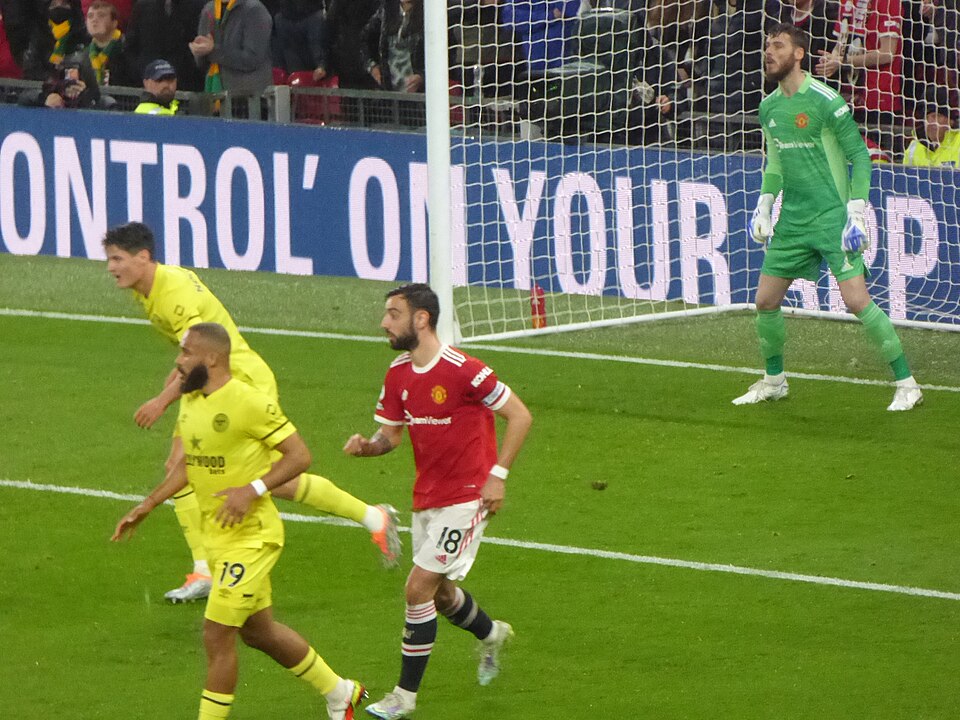
We are living through the end times of football. Not because of corruption, not because of financial doping, not because of the Super League that nearly tore European sport in half. No. We are living through the end times because Bryan Mbeumo used his arm to control a football.
Let us be clear about what happened. In Manchester United’s 3-2 win over Nottingham Forest, Mbeumo — in the build-up to Matheus Cunha’s goal — trapped a cross against his side with his arm. Not to score. Not to gain possession in a dramatic handball moment. To control the ball slightly better. To do what footballers have done since the sport was invented: use their body to manage the ball in flight.
And yet.
Mark Schwarzer and Dion Dublin, two men who have forgotten more about football than most of us will ever know, looked at this moment and saw an “unfair advantage.” Not a handball in the technical sense. Not a deliberate handball. An unfair advantage. The kind of phrase that makes you wonder if we have collectively decided that football is now a sport played by androids in climate-controlled chambers, where every micro-movement is logged, analyzed, and judged against an invisible standard of purity that has never existed.
This is where we are. This is the conversation we are having in 2026.
The original handball rule existed for one reason: to prevent players from throwing the ball into the net, or catching it, or carrying it like a rugby player. It was a line in the sand between football and every other sport. Then we spent fifty years making it worse. We added intent. We added handball in the box that makes no sense. We added the armpit rule, which sounds like a medical condition. We added the handball in the build-up, which is where we are now.
And now we have arrived at the logical conclusion: a player cannot control a football with his arm without sparking a national inquiry into the very fabric of competitive integrity.
Let us imagine, for a moment, that the VAR had disallowed the goal. What would have changed? Manchester United would have won 2-2 instead of 3-2. Nottingham Forest would have left Old Trafford with a point instead of nothing. The Premier League table would be fractionally different. And we would all have moved on, never thinking about Bryan Mbeumo’s arm again.
But someone — somewhere — decided this moment mattered. That it was worth discussing on national television. That it represented a fundamental breach of the sporting contract between player and fan. That fairness itself was at stake.
This is the same logic that has given us VAR reviews that last four minutes, goal-line technology that sometimes works, and offside decisions that require three different camera angles and a degree in geometry to understand. We have created a system so obsessed with getting every decision “right” that we have forgotten what sport is for. It is not for perfect justice. It is for drama, for human error, for the kind of controversy that makes you argue with strangers on the internet for three days.
Mbeumo’s arm was not the problem. The problem is that we have decided every arm movement is a problem. We have decided that football must be played in a state of permanent anxiety, where the smallest contact with the ball using the wrong limb is a potential crime scene waiting to be investigated.
The real question is not whether Mbeumo gained an unfair advantage. The real question is: what have we done to a sport that we felt the need to ask that question at all?
Football survived centuries without knowing whether a player’s arm was at a 45-degree angle or a 50-degree angle. It survived without VAR. It survived without the kind of forensic analysis that has turned a simple cross into a constitutional crisis. What it may not survive is another decade of this.
Because here is what happens when you make every decision a matter of intense scrutiny: people stop trusting the game. Not because the decisions are wrong, but because the game itself becomes unrecognizable. You cannot watch a goal and simply celebrate it. You must wait. You must wonder. You must prepare for the possibility that your joy will be taken from you by a slow-motion replay of someone’s arm.
That is not fairness. That is paranoia dressed up as integrity.
Mbeumo’s arm did not break football. But the conversation about Mbeumo’s arm might be the thing that finally does.