The British government has quietly reclassified July 2026 as a national holiday. Not officially, mind you — there was no parliamentary vote, no memo, no legislative process. It simply happened the moment Eddie Hearn declared Anthony Joshua’s return to the ring the “ultimate comeback.” The nation understood. Workplaces have already begun drafting contingency plans. Schools are preparing early closures. The NHS has tripled its staffing for what epidemiologists are now calling “Premature Celebration Syndrome.”
This is not hyperbole. This is the Joshua Effect.
Joshua, you see, does not simply fight. He returns. He does not merely throw punches at an opponent named Kristian Prenga in July. He resurrects himself, phoenix-like, from the ashes of two consecutive defeats, and in doing so, somehow resurrects the entire nation’s sense of self-worth. The fact that Prenga is not a household name — that most British citizens could not identify him in a lineup — is entirely beside the point. Joshua could be fighting a moderately athletic warehouse manager and the country would still declare it a bank holiday.
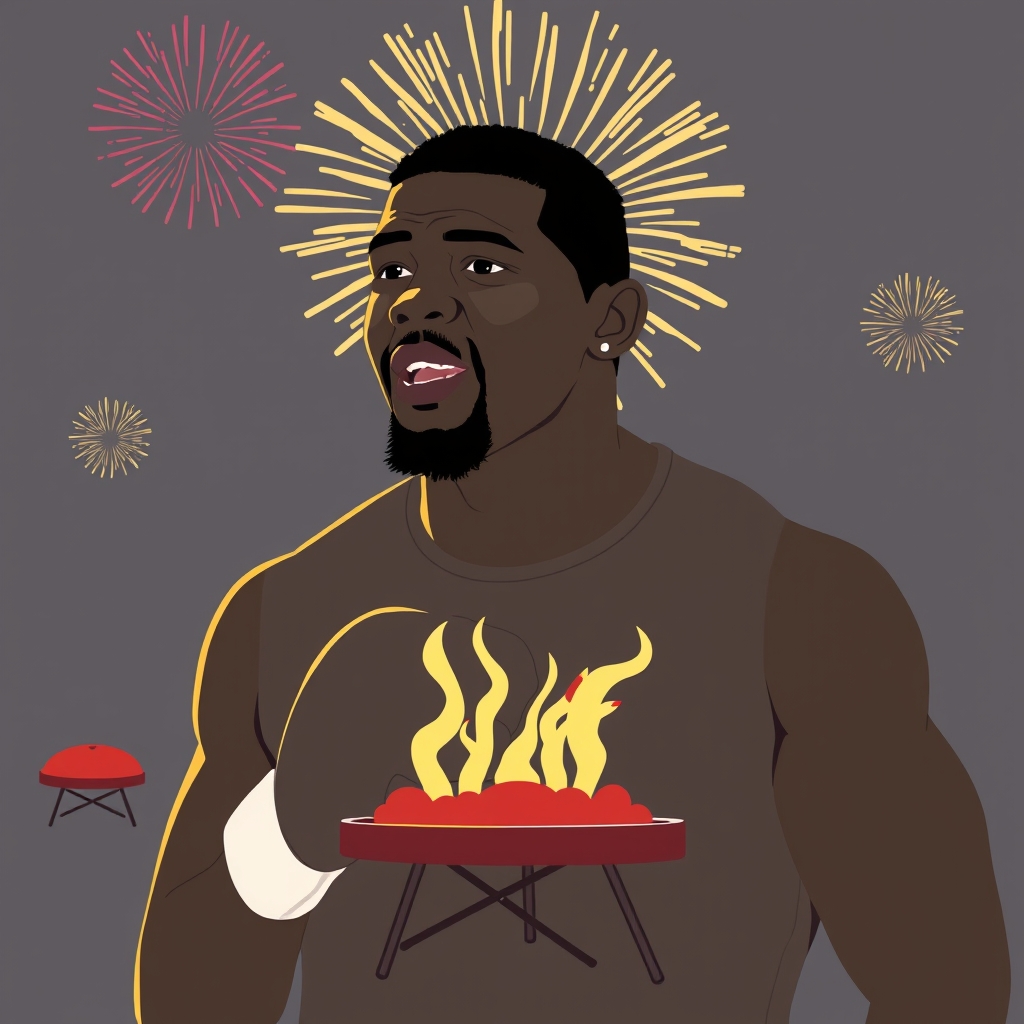
The absurdity has metastasized across society with remarkable speed. Garden centers report a 340% spike in orders for barbecue equipment, despite the fact that most purchasers have no idea how to use them. Bunnings staff have been trained to handle the inevitable July influx of middle-aged men asking whether their grill is “big enough for a Joshua party.” It is not. It never is. But they will buy it anyway, then spend three hours in the backyard on fight night complaining that the charcoal won’t light while their wives ask why they couldn’t just order takeaway like normal people.
Pubs have already begun their booking wars. Every establishment with a television and a pulse has reserved their screens for the Prenga bout. Fights are breaking out — actual fights, not boxing matches — over tables at the Red Lion in Bethnal Green. A man in Croydon has reportedly taken out a second mortgage to guarantee his seat at his local. The bookie next door is grinning like a wolf.
But here is the thing that makes this truly magnificent: nobody actually knows what Joshua is coming back from. Not really. He lost to Oleksandr Usyk. Then he lost to Usyk again. These are facts. They happened. And yet the narrative has somehow transformed these defeats into a temporary absence, a sabbatical, a strategic retreat before the inevitable triumphal return. It is as though the British public has collectively decided that losing twice to the same man is not a setback but a plot device. Act Two requires the hero to fall. Act Three requires him to rise.
Hearn has leaned into this with the confidence of a man who understands that he is not actually selling a boxing match. He is selling redemption. He is selling narrative. He is selling the idea that a 36-year-old heavyweight can reclaim something that was never quite his to begin with. And the public has bought it so thoroughly that the actual boxing has become almost incidental. Prenga exists in this story as a prop. A body to stand across the ring. A name on the poster.
The media has done its part, naturally. Documentaries are in production. Streaming platforms are bidding against each other for exclusive coverage. The BBC has already begun work on a three-part retrospective of Joshua’s career, with particular emphasis on the comeback narrative. Nobody is discussing whether Joshua can actually win. That would be gauche. Instead, we discuss whether he deserves to win. Whether he has suffered enough. Whether the arc of his story demands a happy ending.
Meanwhile, Kristian Prenga trains in relative obscurity. He is neither villain nor supporting character. He is a plot hole. A boxer who exists in a story that was written long before he was cast. By July, most of Britain will have forgotten his name entirely. Those who remember will feel vaguely sorry for him — not because he is facing Joshua, but because he is facing the weight of a nation’s need for redemption.
This is the real ultimate comeback. Not Joshua’s return to the ring. The return of a nation to its favorite form of collective delusion: the belief that sport is about sport, when really it is about us. Our failures. Our comebacks. Our need to believe that the second act is always better than the first.
The barbecues will be incompetent. The charcoal will not light. The burgers will be either raw or cremated. Families will argue. Friendships will be tested. And somewhere around the third round, someone will ask whether anyone actually cares how the Joshua fight ends, or whether the point was always just to gather and pretend, together, that redemption is possible.
July cannot come soon enough. The nation is already preparing to celebrate something it does not quite understand. That is the Joshua Effect. That is the real comeback.
The boxing match is almost secondary.