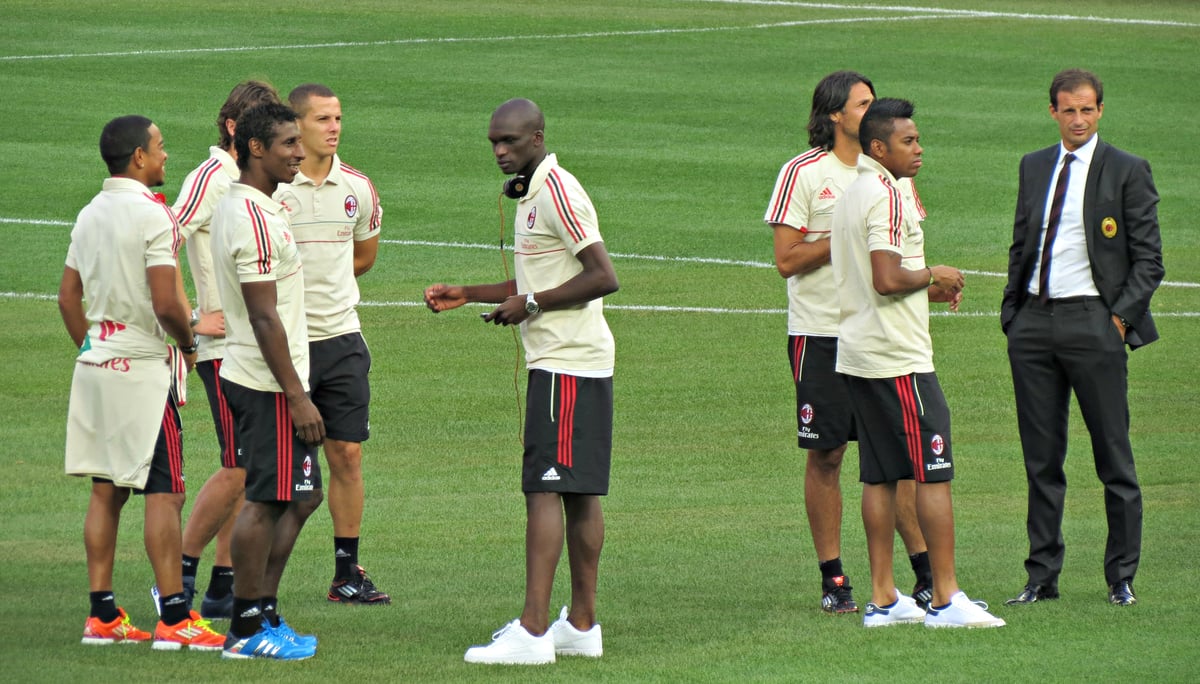
The Lombardy Regional Government convened an emergency session on Tuesday morning after AC Milan announced the termination of Massimiliano Allegri’s contract. By noon, the city had activated its crisis management protocols. Schools were advised to dismiss early. Public transport operators were placed on standby. The mayor’s office issued a statement urging citizens to remain calm and avoid gathering in large groups near the Duomo, where unofficial vigils were already forming.
The charge sheet against Allegri was unambiguous: “unequivocal failure.” The club’s hierarchy had deployed this phrase with the precision of a prosecutor closing arguments. One season without Champions League football. One season of not winning enough matches. One season of existing in the Europa League, that graveyard of continental ambition where Milan fans go to pretend they are still relevant.
What followed was not a managerial sacking. It was a civilisational reckoning.
By Wednesday morning, the Italian media had begun the work of national mourning. Gazzetta dello Sport ran a front-page photograph of Allegri in black and white, as if he had died. RAI Sport commissioned a three-hour documentary examining the exact moment the season became “unequivocally” failed—was it the 2-1 loss to Juventus in February? The draw with Monza in March? The moment someone in the boardroom said the word “unequivocal” out loud and it became real?
Milan’s ultras released a statement that read less like a fan response and more like a ransom note. They did not demand Allegri’s head—they demanded answers. They demanded clarity. They demanded to know how a season could be “unequivocal” in its failure when Milan had, technically, won some matches. The logic was sound. The ultras were right. The club’s use of the word “unequivocal” was doing a lot of heavy lifting, and it was not clear the word could bear the weight.
By Thursday, the discourse had metastasized. Social media erupted into the kind of argument that only Italian football fans can manufacture: was the failure truly unequivocal, or was it merely equivocal? Was it a failure at all, or was it a failure to succeed? If a season fails in the San Siro and no Champions League football is present to hear it, does it make a sound?
The city’s psychiatric services reported a surge in appointments. One therapist told Corriere della Sera that she had seen three Milan supporters in a single afternoon, all of them struggling to articulate what “unequivocal” meant in Italian, and whether it applied to their emotional state. One patient wept while holding a printout of the club’s official statement, circling the word repeatedly with a red pen.
Meanwhile, the search for Allegri’s replacement began in earnest. The club’s scouts were tasked with finding a manager who could deliver the one thing Milan’s season had failed to deliver: equivocation. Nuance. The ability to lose matches while maintaining plausible deniability about whether those losses were actually losses. Someone who could take the club to eighth place and call it “progress within the context of a transitional framework.”
The irony, of course, was that Allegri had spent the entire season doing exactly that. He had lost matches while explaining them away. He had missed the Champions League while insisting that next season would be different. He had operated in a state of perfect equivocation. But then the club’s hierarchy had looked at the standings, looked at the word “unequivocal,” and decided that equivocation was no longer acceptable. The season had to be named. It had to be called what it was. A failure. Unequivocal. Final.
By Friday, Milan had recovered enough to begin the next cycle of hope. The internet was already thick with speculation about potential replacements. Each candidate came with a curriculum vitae and a promise: I will not fail unequivocally. I will fail with style. I will fail in a way that keeps you interested.
The city, slowly, returned to normal. Schools reopened. Public transport resumed its usual schedule. The mayor’s office stood down the crisis team. But something had shifted. Milan fans had glimpsed the void—that moment when a club’s hierarchy uses a word like “unequivocal” and means it. Not metaphorically. Not in the context of Italian football’s usual hyperbole. But actually, really, truly.
One season without Champions League football had become a national emergency. Not because Milan had failed—they had failed before, and they would fail again. But because they had failed unequivocally. And there is no coming back from that. Not until the next manager arrives and starts the whole thing over again.