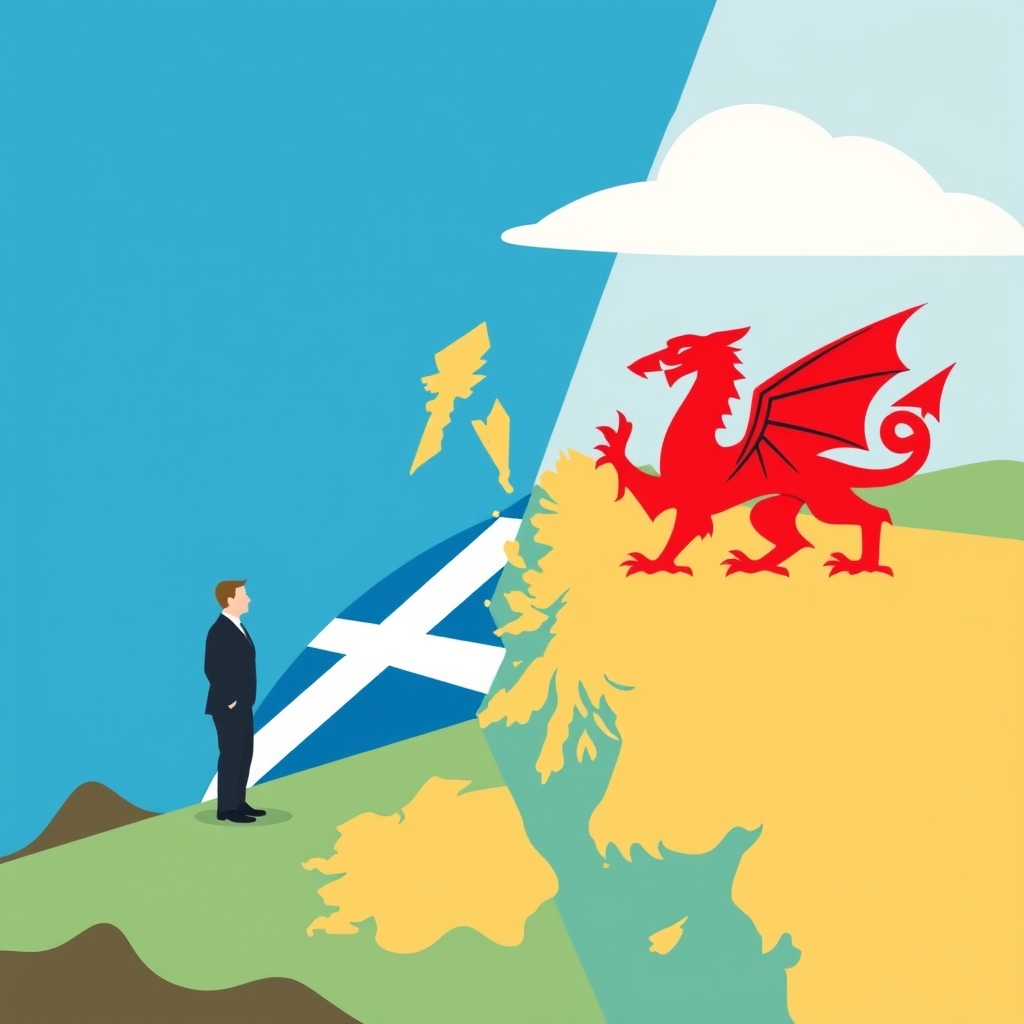
Two nations have simultaneously decided that their individual political crises were insufficient and have agreed to make each other’s problems worse. Rhun ap Iorwerth is about to become Wales’s first minister after Plaid Cymru’s historic win, while John Swinney has somehow convinced Scottish voters to give the SNP a fifth consecutive electoral victory. Between them, they have inherited two collapsing public services, two separate constitutional grievances, and now the shared responsibility of pretending they have a plan.
Ap Iorwerth, a broadcaster-turned-politician, has the distinction of arriving at power at precisely the moment when Welsh politics has exhausted all its other options. His party spent years in disarray. The Welsh government before him spent years in actual scandal. So naturally, voters decided the answer was a man who spent most of his career on television. This is what happens when the bar is set so low that simply not being actively investigated becomes a competitive advantage.
Swinney returns as Scotland’s first minister for the fifth time because apparently Scottish voters have concluded that consistency is more important than progress, and that John Swinney’s face on the ballot is a sufficient platform. The SNP has won five elections in a row. This is either a sign of remarkable political competence or a sign that Scottish voters have given up hope of alternatives and are just voting on muscle memory. The SNP’s own calculations suggest it’s the latter.
What makes this a genuine coalition is that neither leader can actually govern alone. Ap Iorwerth will need to negotiate with other parties to pass anything in the Senedd. Swinney will need to maintain his coalition arrangements at Holyrood. The practical result is that both nations have elected governments that require permission from multiple parties just to function. This is not a sign of healthy democracy. This is what happens when voters are so exhausted by politics that they vote for stalemate as a form of protest.
Why would two nations simultaneously embrace political structures designed to prevent anything from happening? Because the alternative—giving either government a clear mandate—would require trusting them to use it responsibly. Neither electorate has that confidence. Welsh voters looked at the available options and chose the broadcaster. Scottish voters looked at the available options and chose the same guy they’ve chosen four times already. When your political system offers only exhaustion and déjà vu, you pick the one that at least has decent television instincts.
The real comedy is that both governments are now in the position of having to explain to their voters why nothing will change. Ap Iorwerth will blame Westminster and the coalition partners. Swinney will blame Westminster and the coalition partners. Both will be correct, which is the worst possible outcome because it means voters have no one to hold accountable except themselves for voting for this arrangement.
Wales and Scotland have not formed a coalition with each other—they lack the constitutional machinery for that kind of drama. What they have done is create two separate governance structures designed to prevent single-party rule, at a moment when their voters are desperate for something, anything, to work. The irony is so thick you could ladle it. Two nations, two new governments, zero expectation that either will accomplish anything beyond surviving until the next election.