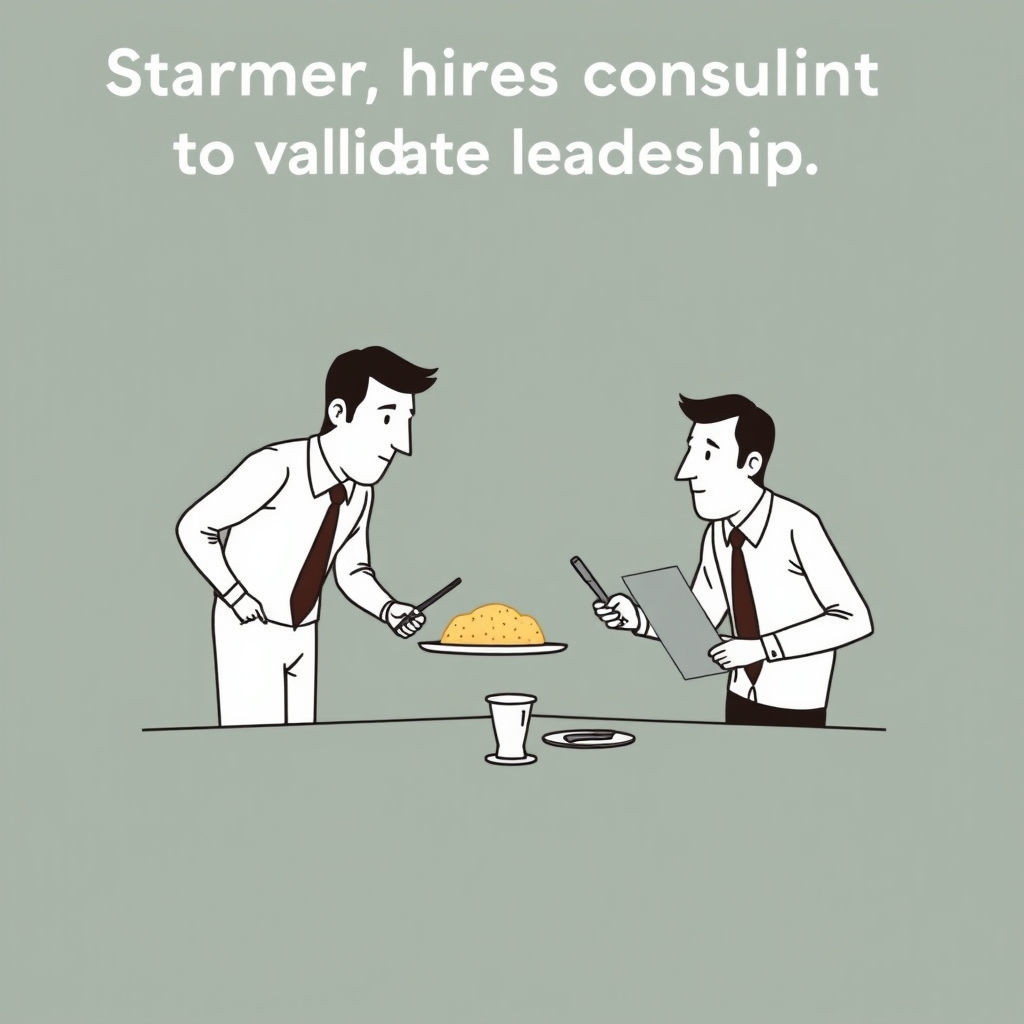
Keir Starmer has discovered the ultimate solution to opposition credibility: outsourcing it. Labour’s leader is now employing a consultant to vet his leadership decisions, which is exactly what you do when you want people to trust your political instincts—you hire someone else to have them for you.
The logic here is bulletproof. If Starmer made a decision on his own, people might think he’s just a politician making decisions. But if a consultant makes the same decision, stamps it with a logo, and presents it in a deck with forty-seven slides, suddenly it’s strategy. It’s vision. It’s someone else’s problem if it goes wrong.
This is not a new phenomenon. Politicians have been paying consultants to tell them what they already think for decades. The consultant’s job is not to provide insight—it’s to provide cover. When a decision fails, you can always say the consultant recommended it. When it succeeds, you can say you hired the consultant who recommended it. Win-win, assuming you don’t count the £500,000 sitting in someone’s Notting Hill office.
What makes Starmer’s move genuinely absurd is the timing. Labour is supposed to be an opposition party. Opposition means opposing things. It means having instincts sharp enough to spot when the government is doing something stupid. But if you’re outsourcing those instincts to a consultant, you’re not opposing—you’re committee-ing. You’re turning every political decision into a procurement process.
The consultant will arrive with a framework. There is always a framework. It will have five pillars. The pillars will be named things like “Authenticity Architecture” and “Credibility Cascade.” None of these words mean anything. All of these words will appear in the final report, which will cost £250,000 and take six weeks to produce. The report will conclude that Labour should be more credible, which is what you’d get from asking anyone who has ever watched television.
Here’s the real problem: effective opposition requires conviction. It requires the ability to look at a government policy and say “that’s wrong” without needing validation from someone with an MBA and a retainer agreement. Starmer is essentially admitting he doesn’t trust his own political judgment enough to deploy it without external certification. Which is fine for hiring a plumber. It’s less ideal for leading a political party.
The consultant will probably recommend things like “clearer messaging” and “stronger narrative coherence.” These are consultant words for “say things that make sense.” Starmer could have figured this out by reading a newspaper. Instead, he’s paying someone to read the newspaper and then explain the newspaper back to him in a PowerPoint.
The real genius is that this creates a perfect feedback loop. When Labour’s opposition strategy fails—and it will, because no consultant can fix the fundamental problem of being in opposition to a government that owns all the levers—Starmer can blame the consultant. When it succeeds, he can credit his leadership instincts. The consultant gets paid either way and never has to run for anything.
Meanwhile, the actual opposition—the kind that requires snap decisions, political intuition, and the willingness to look ridiculous in pursuit of principle—gets replaced by a process. Everything gets workshopped. Every statement gets run through a credibility matrix. By the time Labour is ready to oppose something, the government has already moved on to the next scandal.
This is what happens when politicians stop trusting politics. They import the language and methods of corporate management, which is fine if you’re running a supermarket chain. It’s catastrophic if you’re supposed to be the democratic check on executive power. A supermarket needs consultants. A functioning opposition needs guts.
Starmer’s consultant will probably be very good at their job. They’ll produce excellent documentation. They’ll have a clear strategic vision. And Labour will still be in opposition, still be struggling with message discipline, and still be paying someone to tell them what they already know but couldn’t quite say out loud. Which is, ironically, exactly what a consultant is for.