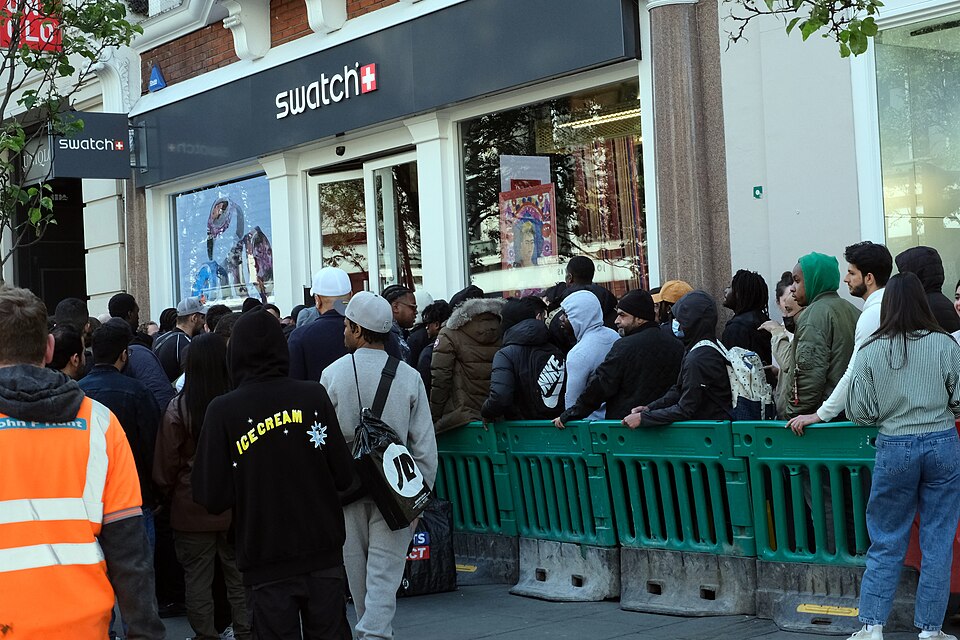
Swatch has closed its stores for a second consecutive day, not due to a supply chain crisis, a cyberattack, or even a genuine public health emergency. Instead, the Swiss watchmaker has been forced to shutter locations across multiple countries because too many people want to buy a £335 pocket watch.
Let that sink in. In 2026, when you can check the time on any of the seventeen connected devices currently in your pocket, when atomic clocks synchronize the global financial system to microsecond precision, when your phone tells you the time before you even think to ask—people are queuing around city blocks to purchase a mechanical device that tells you what time it is in exactly the same way it did in 1895.
The pocket watch in question is a collaboration between Swatch and Blancpain, two companies that have collectively decided that the market was not saturated enough with ways to tell time. The product costs £335. For context, that is enough to buy a functional smartwatch, a decent mechanical watch, or approximately six months of actual therapy to understand why you need a pocket watch in the first place.
What makes this genuinely remarkable is not that the watch exists. Luxury goods exist. What is remarkable is that the existence of this single product has caused actual logistical breakdown. Swatch stores became so overwhelmed with customers that the company could not safely operate them. This is not hyperbole—this is the official reason given. The infrastructure designed to sell watches could not handle the demand to buy a watch.
This is what consumer culture looks like when it has fully eaten itself. We have reached the point where a watch—an object whose entire purpose is to answer a question nobody is asking anymore—becomes so desirable that civilization has to take a timeout.
The crowds did not form because the watch solves a problem. It does not. The crowds formed because the watch is rare, because it is a collaboration, because it costs enough money to feel exclusive but not so much that only billionaires can afford it. It formed because in a world where everything is available instantly and infinitely, the mere fact of something being limited—of not being able to have it immediately—has become the ultimate luxury.
This is the consumer equivalent of a financial bubble. The pocket watch has no intrinsic value beyond what people have collectively agreed to assign to it. Its desirability is entirely self-referential: people want it because other people want it. Swatch did not create demand for pocket watches; Swatch created artificial scarcity, and human psychology did the rest.
The really dark comedy here is that this is not even new. This is how luxury goods have always worked. What is new is the scale and the transparency of it. We used to hide the absurdity behind marketing language and aspirational imagery. Now we just close the stores because the crowds are too large. We have stopped pretending that there is any reason for this beyond the fact that we want what we cannot have.
Swatch will reopen its stores. People will eventually buy the pocket watch or they will not, and the ones who do will carry around a mechanical device that does nothing their phone cannot do, and they will feel something—satisfaction, status, connection to a fictional version of themselves that appreciates fine timepieces. And that feeling, that tiny dopamine hit from owning the scarce thing, is worth £335 to them. Worth enough to queue for hours. Worth enough to close an entire retail operation.
This is fine. This is completely fine. This is just what happens when you give people enough leisure time and enough money and tell them that meaning comes from accumulating things. The pocket watch is not the problem. The pocket watch is just the symptom. The pocket watch is what consumer culture looks like when you stop even trying to pretend it is about anything other than the pure, distilled desire to own what other people want.
Swatch stores will reopen tomorrow or the day after. The queues will form again, probably. Some people will get the watch. Most will not. And everyone involved will feel like they participated in something significant, when really they just participated in a very efficient transfer of money from their bank account to Swatch’s bank account in exchange for a device that tells time.
Which, to be fair, is what it does. It tells time. Just like everything else.