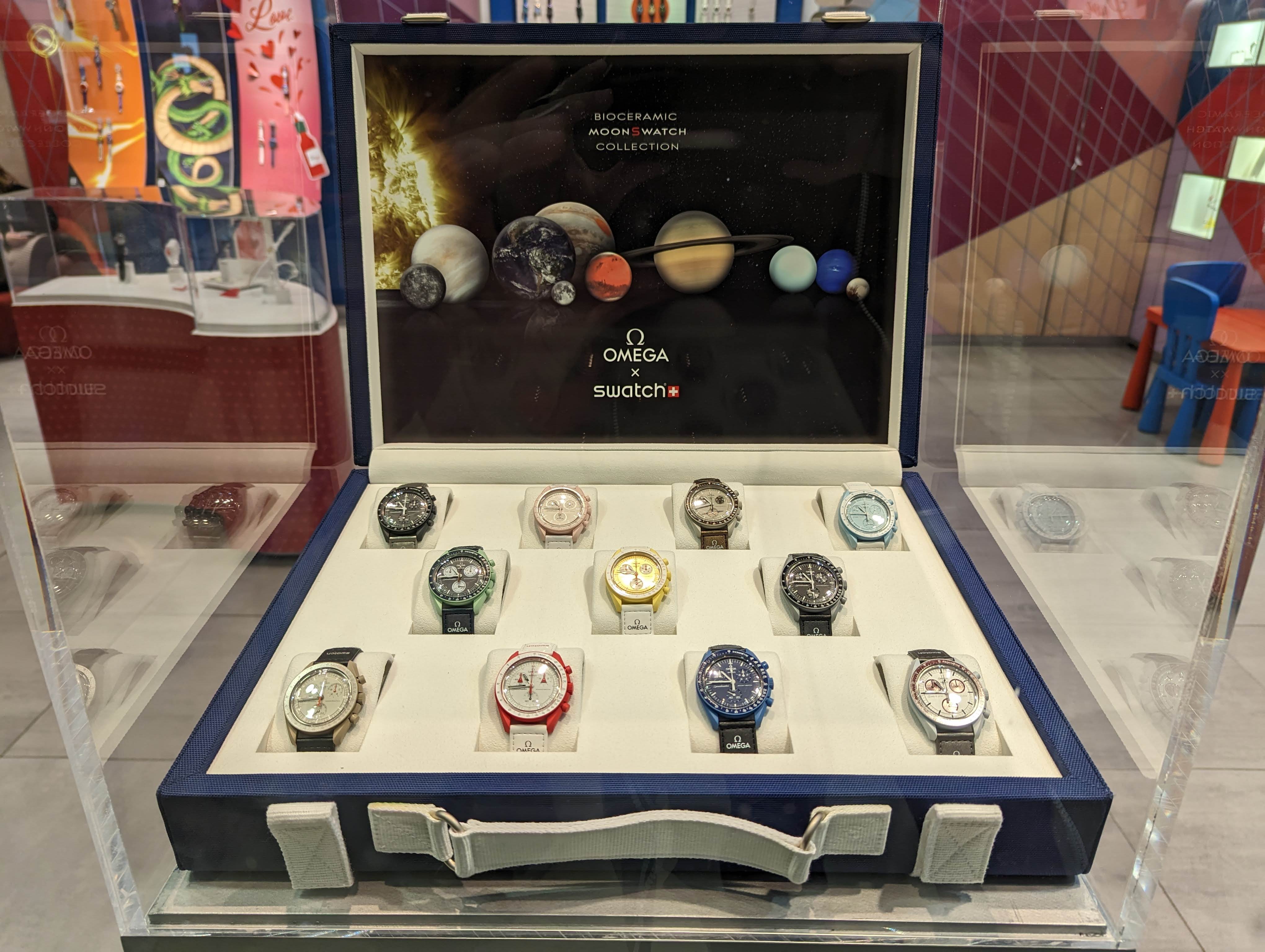
There is a pocket watch. It costs about £40 to manufacture. Swatch is selling it for roughly £1,000 on the secondary market. Stores have closed. Police have shown up. People have camped outside in the rain. This is not a limited-edition Ferrari or a house in central London. This is a watch that tells time slightly worse than your phone does and fits in your pocket like a tiny, expensive paperweight.
Welcome to 2026, where the line between rational consumer behavior and collective financial delusion has become so blurred that it might as well not exist.
The mechanics of this particular madness are almost beautiful in their simplicity. Swatch released an exclusive pocket watch with limited availability. The moment scarcity entered the chat, something switched in the human brain—the part that remembers our ancestors had to fight over resources to survive. Except now the resource is a quartz timepiece in a plastic case, and the fighting happens outside a mall in Manchester.
What makes this genuinely fascinating—and by fascinating, I mean deeply unhinged—is that we have seen this exact movie before. Sneaker drops. Gaming consoles at launch. NFTs. Beanie Babies, for those old enough to remember when people’s retirement plans hinged on owning a stuffed bear with a unique tag. Each time, the pattern is identical: artificial scarcity creates perceived value, perceived value creates demand, demand creates resale markets, and resale markets create a financial incentive to treat the original product like a commodity futures contract rather than something you might actually use.
Here is where it gets properly absurd: the people queuing around the block for this watch are probably the same people who complain about inflation, worry about their mortgage, and scroll through think pieces about why young people cannot afford houses. And they are not wrong about those things. Inflation is real. Housing is genuinely unaffordable in most developed economies. But then—and this is the part that makes you want to laugh until you cry—they turn around and drop a grand on a pocket watch because it is scarce and therefore must be valuable.
This is not economics. This is psychology dressed up as investment.
The truly maddening part is that the financial incentive structure actually works. If you bought one of these watches at retail and flipped it immediately, you made a 2,400% return on your money in a matter of hours. That is objectively better than your savings account is doing. It is better than most stock market returns. It is better than literally any legitimate investment available to a regular person right now. So why would you not do it?
Because the moment everyone thinks that way, the whole system collapses. The secondary market price only holds if there are enough people willing to pay £1,000 for a pocket watch. The moment those people realize they are the last ones holding the bag—that they bought at peak madness and now need to sell to someone even more delusional than they are—the price crashes faster than a tech stock in a bear market.
This is what financial markets call a “bubble,” and what everyone else calls “obvious nonsense that will end badly.” The difference is that with bubbles in stocks or real estate, there is at least a theoretical argument that the underlying asset has intrinsic value. A house provides shelter. A stock represents a claim on future earnings. But a pocket watch? The intrinsic value is “it tells time, but worse than your phone.”
The economic backdrop makes this even more delicious. Interest rates are still elevated. Consumer debt is at record levels. Real wages have barely budged in years. Pensions are underfunded. The housing market is held together with duct tape and prayers. And yet, somehow, enough people have enough disposable income—or enough access to credit—to drive a pocket watch into four-figure pricing territory.
That is not a sign of a healthy economy. That is a sign of an economy where capital is so abundant and so desperate for returns that it is chasing yield anywhere it can find it, including in a piece of plastic and quartz that a teenager could have designed in their bedroom.
The real kicker is that this behavior is not even irrational from an individual perspective. If you genuinely believe you can flip the watch for more than you paid, you are making a rational financial decision. The irrationality only emerges when you zoom out and realize that thousands of people are making the same rational decision simultaneously, which means most of them will be wrong. Someone is going to be left holding a £1,000 pocket watch they cannot sell, and they will be surprised, even though the outcome was mathematically inevitable.
So here is what you should actually do with this information: nothing. Do not buy the watch. Do not try to flip it. Do not convince yourself that you spotted the next big thing. The moment you feel the urge to queue up for something because it is scarce, that is your signal that you are about to participate in a financial decision that will feel brilliant for about six weeks and then feel stupid for the next six months.
Instead, take whatever money you were going to spend and do something genuinely radical: put it in a boring index fund, pay down debt, or just leave it in a savings account. These things are not exciting. They will not give you a story to tell at parties. They will not make you feel like you spotted a trend before everyone else. But they also will not leave you holding a pocket watch that nobody wants to buy at any price.
The economy is a rollercoaster right now. Inflation, interest rates, geopolitical risk—there is plenty of genuine uncertainty to worry about. But the one thing you can control is whether you participate in the collective delusion that a £40 pocket watch is worth £1,000 because it is scarce. You cannot control the Fed. You cannot control the housing market. But you can absolutely control whether you show up to a store at 5 a.m. for a watch.
Make the rational choice. The pocket watch will be fine without you.