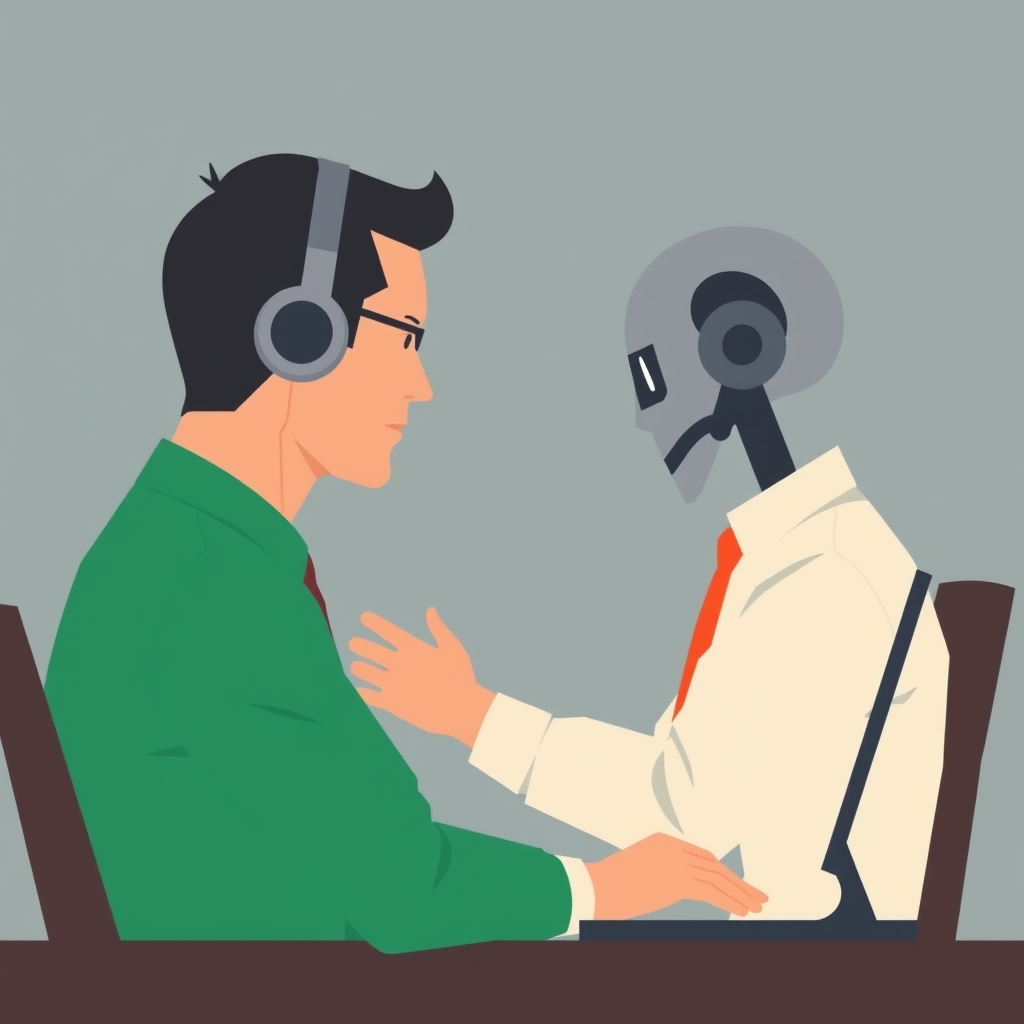
We have reached a peculiar inflection point in human history where we are simultaneously convinced that artificial intelligence will destroy our livelihoods and absolutely committed to making sure it does.
Eric Schmidt, the former Google CEO who spent years insisting that AI was the future and we should all get on board or get left behind, recently discovered what happens when you tell a room full of graduates that their future is automated. They booed him. Not metaphorically. Actual booing. The man who helped build one of the world’s largest AI empires stood before the next generation of workers and watched them reject the gospel he came to preach. It is almost as if telling young people that their skills are about to become obsolete is not a motivational speech.
But here is where the farce deepens: those same graduates, and millions of workers like them, are right now training the systems that will replace them. They are writing prompts, labeling datasets, correcting AI outputs, and generally teaching machines to do their jobs better than they do. It is the professional equivalent of a salmon swimming upstream to spawn—except the salmon at least knows why it is doing it.
The Royal Observatory recently warned that instant AI answers trivialize human intelligence and create unhealthy dependence. Fair point. Why spend three years learning astronomy when you can ask a chatbot and get an answer in 0.3 seconds? The Observatory’s argument—that human knowledge and the process of acquiring it matter—is correct but increasingly quaint. We have collectively decided that the speed of an answer matters more than the depth of understanding behind it. Then we act shocked when people stop bothering to understand anything.
Meanwhile, Eben Upton, the boss of Raspberry Pi, is warning that AI could scare people away from tech jobs entirely. This is the real productivity crisis no one is talking about. It is not that AI will steal jobs. It is that humans, having watched AI steal jobs, will refuse to train for the jobs that remain. Why spend four years learning to code when there is a 40 percent chance your code will be written by a machine before you graduate? Why become a data analyst when your entire job description can be executed by a large language model that never sleeps, never asks for a raise, and never gets bored?
The irony is almost too perfect to be accidental. We built AI systems to make us more productive. To help us work faster, smarter, better. And what we have actually built is a machine that makes our skills feel pointless while we frantically feed it more data to make it smarter. We are not training our replacements out of malice or even carelessness. We are training them because our jobs require it. Because the system demands it. Because if we do not, someone else will, and then we will be left behind anyway.
This is not a bug. This is the feature. This is what productivity gains actually look like when they are distributed upward to capital and sideways to shareholders. The workers get faster tools and the same amount of work. The companies get the same output with fewer people. And somewhere in between, we have all agreed that this is progress.
The students booing Eric Schmidt understood something he was trying to sell them: that there is no winning move in a game where the rules keep changing and you are the one paying to change them. You cannot out-compete a machine that learns from your competition. You cannot out-innovate a system trained on all of human innovation. You can only accelerate the timeline to your own obsolescence.
So we train the machines. We label the data. We correct the errors. We teach them to think faster and better and more efficiently. And then we go home and worry about our futures, which is exactly what we should be doing, because we have just spent the day making sure there is no room in those futures for us.
It is not self-sabotage if you are fully aware of what you are doing. It is just self-interest masquerading as inevitability. And that is the real absurdity—not that AI will take our jobs, but that we will hand them over willingly, one training example at a time, all while pretending we had no choice in the matter.