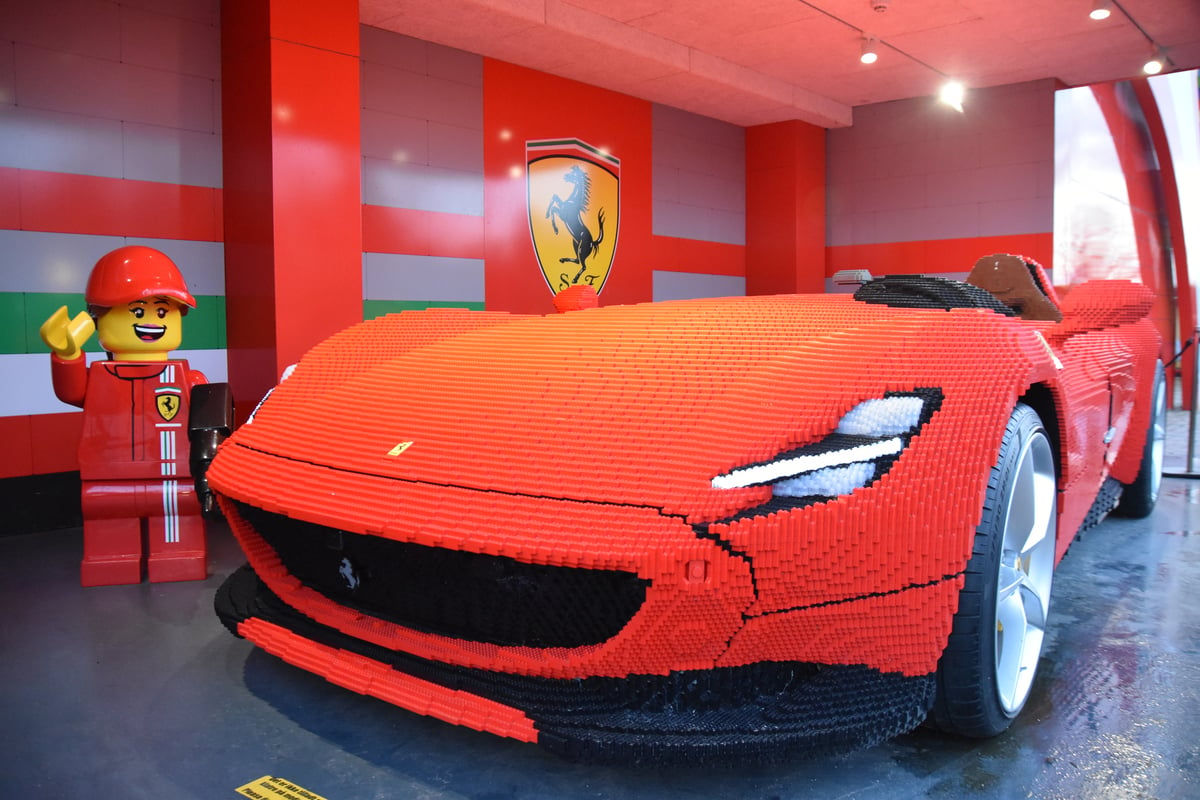
Ferrari has a problem, and it is not a new one. The Italian supercar maker spent seventy-five years building an identity on the principle that more noise equals more soul, that a twelve-cylinder engine is a moral statement, and that environmental responsibility is something other people worry about. Then the world changed. Electric vehicles became inevitable. Chinese manufacturers started eating everyone’s lunch. And Ferrari, faced with the choice of evolve or die, chose the worst possible path: evolution without conviction.
Enter the Luce—Ferrari’s first fully electric vehicle, and a masterclass in having it both ways while satisfying no one.
The backlash has been swift and merciless, and for once, the backlash is correct. Ferrari enthusiasts are apoplectic because the Luce sounds like a hair dryer in a Tesla factory. Environmental advocates are unimpressed because a $300,000 electric car that only wealthy people can afford is not a climate solution—it is a tax write-off with a prancing horse badge. And everyone else is simply confused about why Ferrari is trying to sell them a luxury product by apologizing for what made Ferrari luxury in all.
Here is the actual absurdity: Ferrari built the Luce to compete with Chinese EVs. Not to replace the internal combustion engine. Not to lead a transition. Not because they believe in anything. But because Nio, BYD, and a dozen other manufacturers are selling millions of electric vehicles at prices that make the traditional supercar look like a museum piece. Ferrari looked at this market and asked the question every luxury brand asks when threatened: How do we sell the same thing but make it sound new?
The answer was to strip away everything that made a Ferrari a Ferrari—the visceral engine noise, the mechanical feedback, the sense that you are piloting something that could explode at any moment—and replace it with an iPad that goes very fast. Then they priced it like a Ferrari. Then they acted surprised when people said it does not feel like a Ferrari.
This is not evolution. This is panic dressed up in sustainability language.
What makes this genuinely funny is the contradiction baked into the entire premise. A Ferrari is not a car you buy to save the planet. It is a car you buy to announce that you have transcended planetary concerns. It is a car that says: I have enough money that carbon emissions are not my problem, they are someone else’s problem. The Luce tries to square this circle by offering the same announcement but with guilt-free conscience. You can still be wealthy and conspicuous, but now you can also feel like you are doing your part.
Except you are not. A six-figure electric supercar does not solve climate change. It does not even meaningfully reduce emissions when you factor in the carbon cost of manufacturing a battery the size of a small apartment. What it does is allow a specific type of consumer—someone wealthy enough to afford a Ferrari but insecure enough to care what Twitter thinks—to feel virtuous while doing exactly what they were always going to do: spend money on a status symbol.
The real crime is not that Ferrari made an EV. Porsche made an EV (the Taycan) and people respect it because Porsche did not pretend the Taycan was anything other than what it is: a very good electric car that happens to have a Porsche badge. Ferrari made an EV and then tried to convince everyone it was still a Ferrari, just quieter and more responsible. That is not innovation. That is gaslighting.
And the backlash proves something important: consumers can smell inauthenticity from a mile away, even when they are the ones being inauthentic. Ferrari fans do not actually want an electric car. They want Ferrari to keep making the thing they love. Environmental advocates do not want a $300,000 luxury vehicle. They want systemic change and affordable alternatives. And wealthy people who buy the Luce are not buying it to save the planet. They are buying it because they want the status of a Ferrari without the social friction of owning a gas-guzzler.
Everyone is lying, and everyone knows everyone is lying, and the Luce is the physical manifestation of that mutual deception.
What happens next is predictable. Ferrari will sell some Luces to people with more money than self-awareness. The backlash will fade because backlash always fades. A new model year will arrive with slightly different headlights. And in a few years, people will stop asking whether the Luce is a real Ferrari because the question will seem quaint—just like people stopped asking whether the SUV was a real Porsche.
But for now, in this moment, the Luce is a perfect mirror held up to the absurdity of late-stage luxury capitalism: the belief that you can buy your way out of any contradiction, as long as the price is high enough and the marketing is slick enough. The Luce proves you can. It also proves that knowing you can does not make anyone feel any better about it.