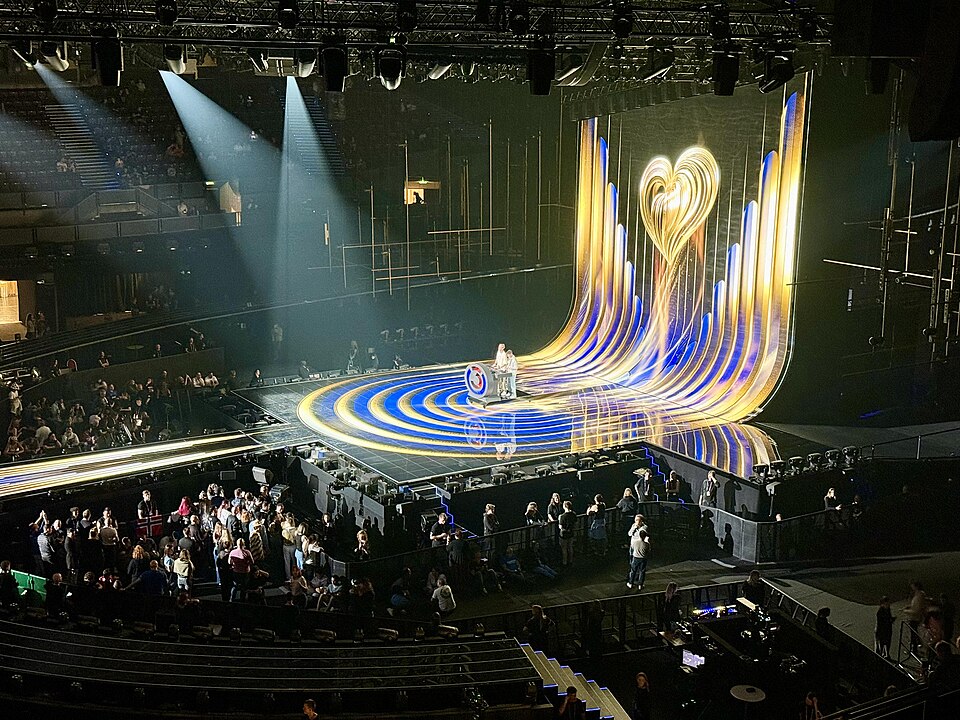
Vienna is hosting Eurovision 2026, which means Europe’s most elaborate karaoke competition has officially become a proxy war with staging and pyrotechnics. Spain pulled out. Ireland pulled out. Austria is hosting the whole thing. And somewhere in the middle of this beautiful mess, a man named Noam Bettan performed a song while the crowd simultaneously cheered, booed, and chanted geopolitical grievances at him.
This is what happens when you build a competition around national pride and then invite nations that are currently experiencing international disputes to compete for a trophy. The trophy is a microphone. The prize money is modest. The geopolitical fallout is incalculable.
Israel qualified for the grand final despite—or perhaps because of—the semi-final crowd’s mixed reception. Boy George did not. This is the actual outcome: a performer with one of the most recognizable voices in pop history got eliminated while a contestant performing under international protest advanced. The voting public has spoken, and what they said was: we care more about the Israel-Palestine conflict than we do about the man who sang “Culture Club.”
Why would Eurovision face its biggest boycott in 70 years over a singing contest? Because Eurovision stopped being about singing approximately three decades ago. It became about national representation, cultural soft power, and increasingly, a referendum on which countries the European Broadcasting Union deems acceptable. When you make a competition explicitly about national identity and then invite nations involved in active geopolitical disputes, you’ve created a system where every performance is a political statement whether the performer wants it to be or not.
The absurdity reaches its peak when you consider what actually matters here. Noam Bettan performed a song. He did not negotiate a ceasefire. He did not broker peace. He sang. The crowd’s response was not a referendum on his vocal abilities but on his passport. Spain and Ireland withdrew not because the music was bad but because they decided the political cost of participation exceeded the cultural benefit of competing for a trophy that costs less than a used car.
Fans are “grappling with how to react,” according to observers, which is a polite way of saying they’ve discovered that their favorite glittery song competition has become morally complicated. This is what happens when you ask people to celebrate national achievement while the world is on fire. They either pretend the fire doesn’t exist, or they show up to the concert and yell about it.
The real question isn’t whether Eurovision can survive this. It’s whether Eurovision should survive this in its current form. A competition explicitly designed around national pride and international competition will inevitably become a battleground for international disputes. You cannot build a system that says “countries, send us your best performers and let’s celebrate your national identity” and then act surprised when countries with active conflicts show up and the crowd turns it into a political statement.
What Eurovision 2026 has accidentally revealed is that the contest’s entire premise—that music transcends politics—was always a comfortable lie. Music doesn’t transcend politics. Music is politics. The staging, the voting, the qualification rules, the decision to invite certain nations and not others, the crowd’s response to a performer’s passport—it’s all politics. Eurovision just spent 70 years pretending it wasn’t.
Noam Bettan qualified anyway. The show will go on. Somewhere in Vienna, someone is checking whether the pyrotechnics budget can be increased to drown out the chanting. The trophy still exists. The prize money is still modest. And Europe’s most elaborate karaoke competition is now also its most elaborate geopolitical statement, which means it’s finally honest about what it’s always been.